

II. The relationship between former German governments and the Russian Federation. Old supporters of Russia.
They key question is: who ruled the German government during that time? Who was the Chancellor of Germany, who was the minister of Defense and who was the Foreign Minister of Germany? The Chancellor of Germany at that moment was no other than Dr. Angela Merkel, which was proposed for this function by both CDU and SPD (Social-Democratic Party) at that time. No wander that SPD, the party of Gerhard Schröder, the man who established a key relationship between Germany, Russia and China, was so keen on proposing Dr. Merkel, who continued the same line down the road. The Minister of Defense at that time was Dr. Franz Iosef Jung and the Minister of Foreign Affairs of Germany was Dr. Frank-Walter Steinmeier, the current President of Germany and a member of SPD. One of the most important examples of how Germany should behave in relation with its neighbors, its partners but also in relation to the European Union and NATO is the so-called “White Paper on German Security Policy and the Future of the Bundeswehr, Berlin, 2006” (“Weiβbuch zur Sicherheitspolitik Deutschlands und Zukunft der Bundeswehr, Berlin 2006”), which is the main strategic document of Germany at that time, a quasi-equivalent of a national security strategy. What is it written in that document? Regarding Russia, there are certain interesting remarks within the pages of a strategic and security document that defines how Germany will act in the future when it comes to strategic partners and international organizations.
What does the strategic paper say about Russia?
1. “At the same time, it is essential to develop and deepen a lasting and resilient security partnership with Russia”[1];
2. “The tension between defence-policy requirements and the financial needs of other government responsibilities will continue to exist in the future”[2];
3. “Since the adoption of the NATO-Russia Founding Act in 1997, NATO has maintained a particularly significant relationship with Russia. Within the NATO-Russia Council, which was established in its current form in 2002, the Allies and Russia cooperate on an equal footing, “at 27”. This applies equally to political dialogue and practical cooperation”[3];
4. “Russia occupies a special position in bilateral cooperation due to the formative experiences of our shared history, as well as its particular role as a prominent partner of NATO and the European Union, its size and its potential. Russia belongs to the group of G8 nations, is a nuclear power and a permanent member of the United Nations Security Council […] Russia is an important energy supplier and a major economic partner for many European countries. Security, stability, integration and prosperity in Europe therefore cannot be guaranteed without Russia. Germany has a particular interest in supporting Russia’s modernization through intensified political, economic and societal cooperation. Germany therefore promotes the improvement of Russia’s political, economic and cultural cooperation with the European Union and advocates even closer cooperation with the North Atlantic Alliance”[4].
What does the strategic paper say about China?
1. “The traditionally close and well-established relations with Japan must be complemented by a long-term strategy of partnership with China and India, while the security and economic-policy dialogue with Australia must be further developed”[5];
2. “China has undergone a breathtaking process of development over the past decade. Given its economic, political and military potential, the country’s further development will have a significant influence on the future of the Asia-Pacific region and on international politics. China therefore bears a growing responsibility for safeguarding peace and stability worldwide”[6];
3. “In order to deepen cooperation in assuming global responsibility, the governments of Germany and China have agreed to initiate a strategic dialogue before the end of this year”[7].
Which conclusions can be taken from these interesting statements?
1. First, the 2006 White Paper reflects a fundamentally cooperative rather than deterrence-oriented perception of Russia and China. Neither country is conceptualized primarily as a strategic adversary. Russia is described as an indispensable component of European security, while China is approached as a rising power whose growing international role should be managed through partnership, dialogue and integration into structures of global responsibility. So, while both countries are characterized by a totalitarian regime, the German government is establishing GROWING PARTNERSHIPS with them;
2. Second, the document demonstrates how deeply the German security establishment relied on the assumption that economic and political interdependence could contribute to strategic stability. The statement that European “security, stability, integration and prosperity […] cannot be guaranteed without Russia”[8] is particularly revealing. Russia was not merely considered a state with which Germany had to coexist; it was regarded as an essential participant in the construction of the European security order. Economic cooperation and deeper political partnership were explicit objectives. The dependency that later emerged was not presented as an objective, but it became one of the long-term consequences of this policy, while Europe and its leaders were completely asleep;
3. China as a participant in maintaining international stability. The White Paper recognized China’s rapidly increasing “potential” when it comes to economics, politics and MILITARY aspects. There was proposed a long-term strategic partnership between Germany and the communist China. Very interesting is the word “MILITARY”. Why did the document acknowledge China’s rapidly growing military capabilities while continuing to frame the relationship primarily in terms of partnership and strategic dialogue? What did Frau Merkel really want? ;
4. The fourth conclusion lies within the realm of logic: Russia is explicitly recognized as a nuclear power, a permanent member of the UN Security Council, a major energy supplier and a state possessing considerable geopolitical potential. China is seen as a growing-expanding economy, as having potential in the realms of economy, politics and MILITARY, but the document recommends for a deeper collaboration and cooperation with those states. The problem is a logical one: if you recognize that Russia and China are increasingly expanding their military, political, economic and financial powers, why do you recommend to deeper cooperation and not starting a discussion about how these capabilities might eventually be employed coercively against Germany or its allies?
Very troubling are also statements of Dr. Frank-Walter Steinmeier within the German Parliament on Transatlantic Relations, 7th December 2006: “Our relations with Russia are also of central importance. For Europe, engagement and dialogue with Russia have no alternative. Despite all differences on individual issues, Russia is an indispensable and constructive partner internationally. We seek a lasting strategic partnership with Russia, but precisely for this reason, we will not refrain from critical engagement wherever our convictions or political practices diverge”[9]. The same minister is then diverging the subject and saying that the rule of law and the democratic process is not in a very good shape, rather regressing. Ok, very intriguing, but then why do you maintain STRATEGIC relations with a country that is regressing in its democratization process?
“We also need Russian gas and oil. Here, too, I would advise greater composure. We are not powerless, dependent consumers of energy supplied by a powerful Russia”[10]. Let me get this straight: you need Russian gas and oil, you build Nord Stream 1 but then you are not dependent consumers of energy supplied by Russia?
In the next statement that I want to analyze, there is written that “Angela Merkel wants more America and less Russia because the values we share with the Russians are considerably fewer than those we share with the Americans. […] Our objective must be to expand the common ground of values we share with Russia through engagement and close cooperation”[11]. Well, you want to achieve close cooperation with the United States of America by building a strategic and a security partnership with the Russian Federation, which was and still is the key enemy of Europe, of the European Union and of NATO? How can a close relationship with the US be built in a future in which Germany will become increasingly dependent on Russian gas and oil?
In the archive of Deutschlandfunk, there is also an interview with the former Minister of Defense, Franz Josef Jung, which took place on 02.04.2008. In this interview, Jung is underlining the fact that Georgia and Ukraine are not capable to enter NATO because they cannot generate security for themselves and for the alliance. His argument is that: if we allow them to quickly join NATO, they cannot generate security but they are in need of security. He gives the example of having 20 German soldiers in Georgia in a mission under the mandate of the United Nations. These are only excuses that hide a very dark truth: Germany had no interest in supporting Georgia’s and Ukraine’s accession to NATO. The key question remains: why?
Here is the quotation from the interview: “NATO is an institution that provides security, not one that, so to speak, admits states that are still in need of security. To put it plainly: we still have soldiers in Georgia. I have a mandate from the German Bundestag for 20 German soldiers in Georgia […] For this reason, we believe that some more time is needed before we can ultimately take the step towards a Membership Action Plan (MAP) […] The perspective is that, in due course, we certainly envisage both Ukraine and Georgia joining NATO. However, we believe that more time is needed to create the necessary conditions for Georgia and Ukraine ultimately to be able to contribute to providing security themselves, rather than, as is still the case in Georgia, for example, requiring a UN mission to ensure security”[12].
Kiesewetter writes also about one of the most controversial subjects when it comes to Germany and to the rules-based democratic order: the issue of migration. The most important thing that Kiesewetter is doing here is to demystify the subject of migration. He states that migration is used as an instrument by Russia and China in order to weaken the Western societies, to destabilize their political system, so that new radical and populist parties will be born within the society and they will gain more and more popular support. An example is what Lukashenko tried in the summer and autumn of the year 2021, when he put pressure on the EU border with migrants coming from Syria, Afghanistan and Africa. Migrants were used as an instrument in order for certain actors to gain political influence[13]. This exact point can destroy the main political arguments used by many extremist parties that are mostly referring to ‘illegal migration’. The ‘illegal migration’ is an effect of a much more complicated cause. And the cause is: Russia and China:
“For some of the people described as ‘illegal migrants’ are instruments of deliberate hybrid warfare. They are used to undermine the cohesion of the societies receiving them. In Germany, this domestically highly effective aspect of interconnected hybrid and cognitive warfare is exploited for populist purposes, while its underlying causes are almost completely ignored […] Migration as a weapon is one of the most effective and “cost-efficient” instruments of networked warfare. It can achieve several objectives: destabilising host societies, overwhelming the political response system, facilitating the rise of right-wing populist parties and parties that tend to be friendly towards Russia, conducting cognitive warfare against the population, and influencing decision-makers”[14].
This touches a very controversial political debate. At the same time, this argument should be broadcasted all over Europe in order for people to understand which are the root causes of many of the problems within the European Union. Of course, many of them are self-induced. Decades and decades of dependency towards Russia and China was done voluntarily by Europe. Of course, that Russia and China had their agents, their instruments, their propaganda, their disinformation campaigns, their targeted media and their missions written down by their secret services. Of course, Russia and China used intelligence gathering, intelligence analysis, satellites, drones, explosives, sabotage, espionage, useful idiots, and many more instruments. But they are not solely to blame. We are, too. The EU bureaucrats, the politicians giving public speeches and saying how important democracy and rule of law are, while, in the back, they were signing to give up their sovereignty to Russia and China. Many people are today screaming that the member states are giving too much sovereignty to the European Union. In my opinion, this is wrong. The main problem is that the European Union and the member states gave up too much of their sovereignty to the Russian Federation and to the communist China. This was the main trap set by the CRINK states, to destabilize Western societies from within, without starting a conventional warfare, but through a warfare over people’s consciousness.
The main problem within the German society when It comes to this particular matter is the fact that there is no discussion of the real causes behind migration. Migration is not something spontaneous, there is always a cause behind a grand phenomenon of migration. In our case, the main political actor that triggered migration at this scale is the Russian Federation. I am sure that communist China was also thrilled of the consequences. The first thing that the Western leaders should have done within this matter is to address the main issue: Russia. Because that did not happen, one particular party developed behind the narrative of ‘illegal migration’. This was the Alternative für Deutschland (Alternative for Germany). This party, in bed with the enemy, has moved the problem from its root cause to something that became a problem later, as a consequence of the criminal actions coordinated by Vladimir Putin and Bashar al-Assad, the former President of Syria.
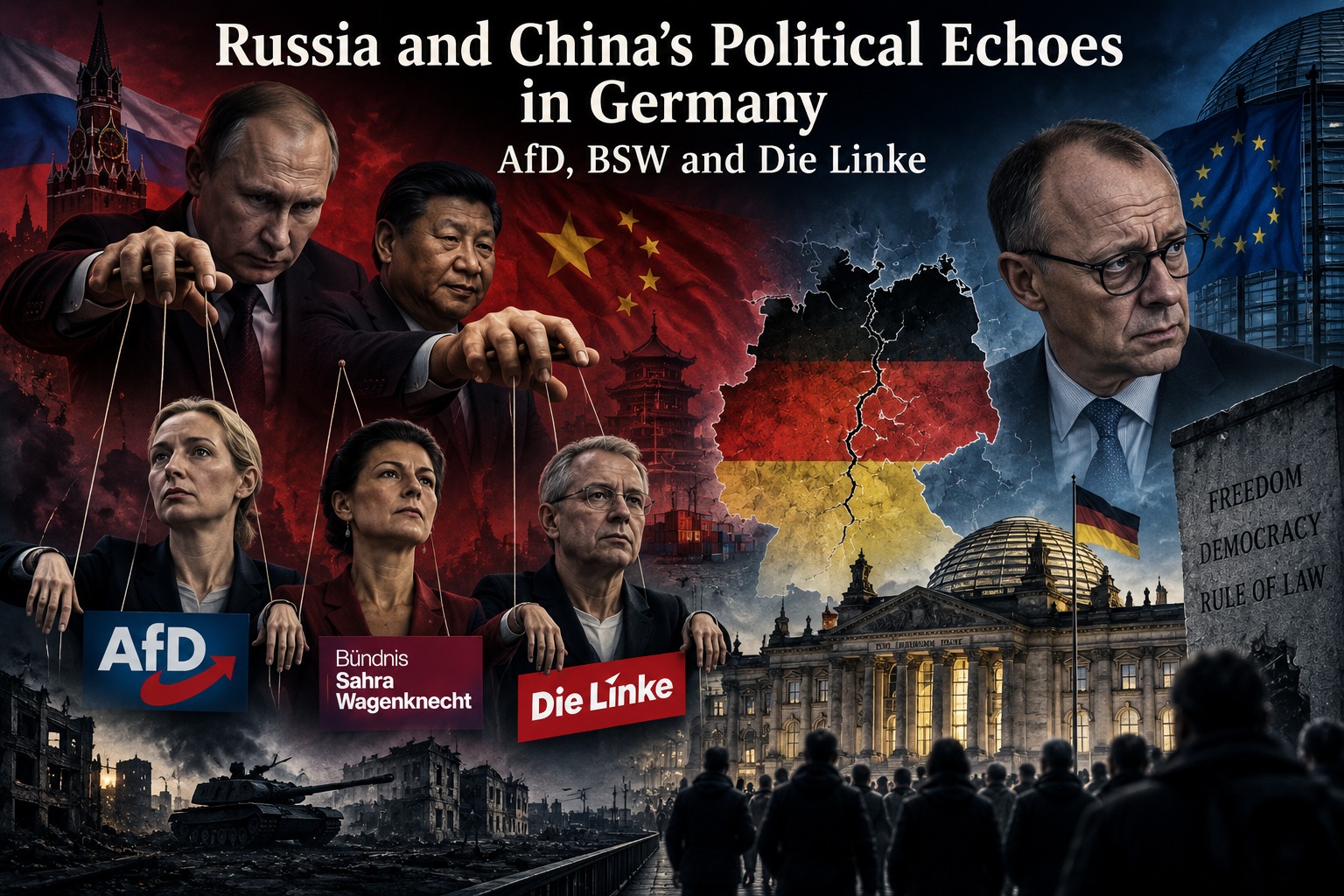
Last but not least, when it comes to the context in which three apparent different political forces, but in reality, one force with three faces, I want to underline the problem represented by the United States of America under President Donald J. Trump. I am fully aware that this subject is a very sensitive one and that it requires more consideration that before. Once I will truly state my case about how is the United States seen by its allies, I know that some of you will think that I somehow exaggerate or that I do not see the full picture. Why is this important for our context? Because the situation of the United States has a huge impact on the current situation of Europe and of the European Union.
In my opinion, the United States is in its transition from democracy to oligarchy. Analyzed in detail by Plato, oligarchy is a political system, where a small number of people with extreme wealth are controlling the society and, thus, exercising power. Power is defined in an oligarchy as economic influence. How does this definition apply to our case? Donald Trump is exercising power, surrounded by the wealthiest people in the world, many of them with a very bizarre worldview, called DARK MAGA, or techno-feudalism. Elon Musk, Peter Thiel, J. D. Vance, Marc Andreessen, David Sacks and many others are the ones who control the means of power not only at national level but at international level when it comes to political, economic or financial consultation, merge & acquisitions, stocks and bonds, critical investments in critical infrastructure, but also at philosophical level. Why am I mixing philosophy with all the things mentioned above? Because these guys are proposing one of the most dangerous ideologies rebranded for the 21st century, meaning a combination between TECHNOLOGY, MONARCHY and FASCISM.
Where does this ideology come from and what does it want? The founder of this dangerous ideology was Curtis Yarvin. Curtis Yarvin developed a worldview in the 1990s saying that democracy must be completely und utterly rejected. His political thought is particularly associated with the concepts of formalism, neo-cameralism, and the “Cathedral”. Yarvin fundamentally rejects liberal democracy, arguing that democratic systems disperse political power among too many institutions and actors, making effective governance and clear accountability difficult. Instead, he advocates the concentration of executive authority. Under his neo-cameralist model, the state would function in a manner comparable to a corporation, governed by a powerful executive resembling a CEO. In its most radical form, this amounts to a modernized form of monarchy in which the ruler possesses extensive executive powers. In other words, the ruler would be like a monarch, but it will behave with the mindset of a CEO.
Another important element of Yarvin’s thought is the concept of the “Cathedral.” He uses this term to describe what he sees as an informal network of universities, the media, bureaucratic institutions, and other cultural elites that collectively shape political discourse and reproduce progressive values, even without being directed by a single centralized authority. What does Yarvin want to do? To destroy the Cathedral after one finds all the elements belonging to the Cathedral. This means not only identifying the political opposition but an intrinsic repression of the political opposition.
[1] Bundesministerium der Verteidigung,“Weiβbuch zur Sicherheitspolitik Deutschlands und Zukunft der Bundeswehr, Berlin 2006, Bundesministerium der Verteidigung“, p. 23, accessed at https://atlantische-initiative.org/files/pdf/wb_2006_dt_mb_3vpvk5ixooa8b2tqizt8ox.pdf on 16.08.2026
[2] Ibidem, p. 12
[3] Ibidem, p. 32
[4] Ibidem, pp. 58-59
[5] Ibidem, p. 60
[6] Ibidem, p. 60
[7] Ibidem, p. 60
[8] Ibidem, p. 59
[9] Stichworte zur Sicherheitspolitik, Presse- und Informationsamt der Bundesregierung, Nr. 11/12 November/Dezember 2006, p. 89, accessed at https://www.bundesregierung.de/resource/blob/976072/760222/fa902e9563c602679744d09cb36c4fa1/2007-01-09-sipo-november-dezember-data.pdf?download=1 on 16.08.2026
[10] Ibidem, p. 93
[11] Ibidem, p. 93
[12] Accessed at https://www.deutschlandfunk.de/jung-nato-kann-keine-staaten-mit-sicherheitsbedarf-aufnehmen-100.html on 16.08.2026
[13] Ibidem, p. 75
[14] Ibidem, p. 77

