

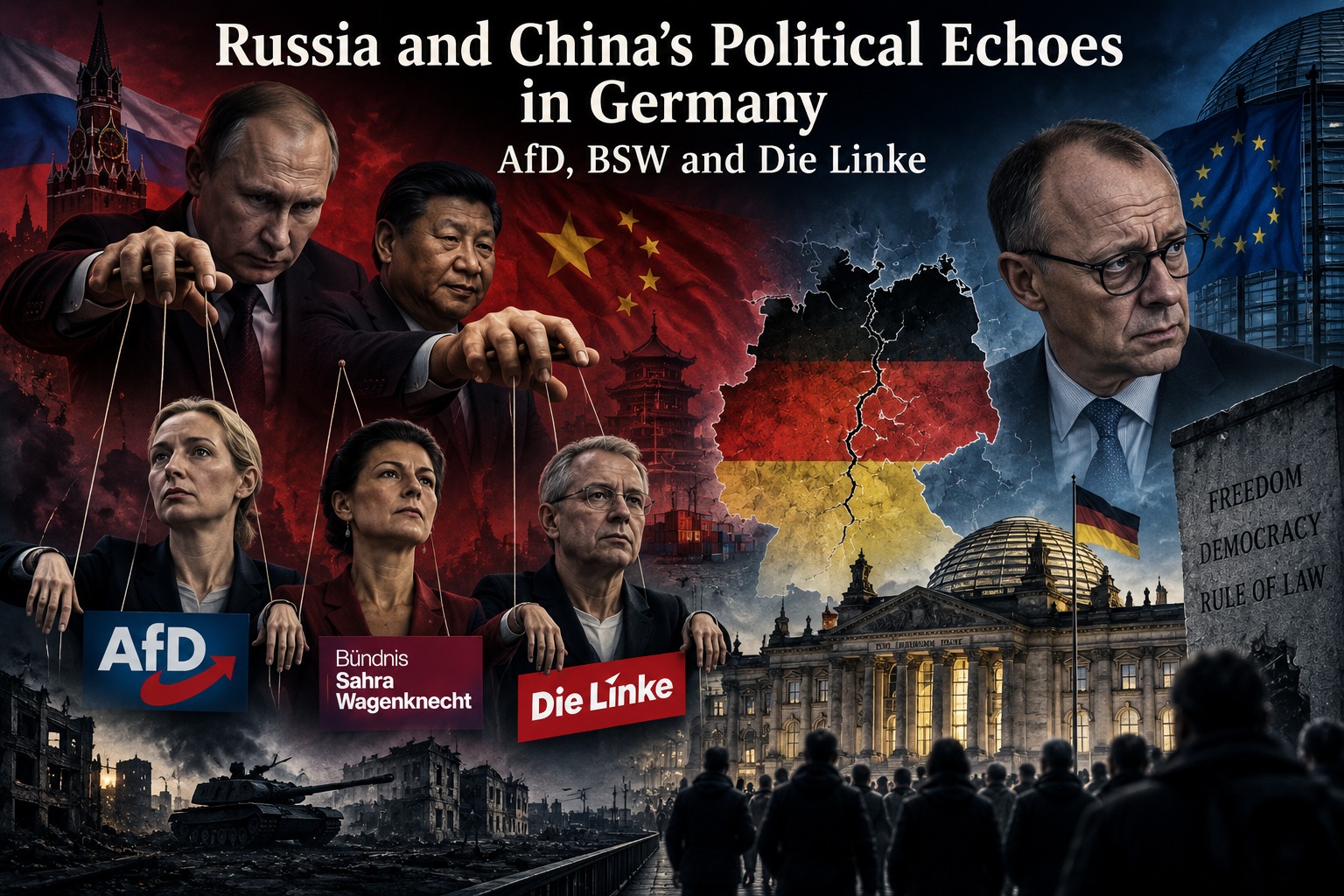
Will democracy survive, or will tyranny prevail? How do Russia and China penetrate Western democracies and shape political decisions? Is Eastern Germany heading towards a democratic catastrophe?
“Who do we want to be? Neville Chamberlain or Winston Churchill? A resilient liberal democracy capable of defending itself? Or an object of imperial autocrats?”[1]
EUROPE IS AT WAR!!!
A different kind of war. We are not experiencing a classical war in comparison with Ukraine, but we are still experiencing a war, maybe a more devastating war: a war for our minds, a war for our consciousness, a war for the control of the European population. After you read these lines, I will agree with you: “what you wrote is nearly impossible”. But I can assure you: it is more devastating than you realize because informational warfare is not conducted through classical weapons, rockets and warheads, but the information is the instrument through which manipulation, propaganda, misinformation and disinformation are formed. In a world where sentences, ideas, and complicated phrases have lost their touch, especially when it comes to the young generation, words are built and surgically weaponized against our core democratic values and principles.
DEMOCRACY IS IN DANGER. THE BIGGER PROBLEM IS THAT WE ARE ALSO TO BLAME. BECAUSE WE DID NOT ACT IN TIME AND NOW IT MIGHT BE A LITTLE TOO LATE.
What could be this danger that fewer and fewer people are talking about? Why do I write this article, and what is the main purpose of this article? OUR DEMOCRACY IS IN DANGER! The rights and freedoms of my generation, my parents’ generation, and my grandparents’ generation are in danger! I wish this would not be true! Unfortunately, it is!
Until now, the real issues of our society were solved peacefully, were solved within a democratic framework, where every voice and every opinion were respected. When someone spoke about something, there was no risk. There was freedom of expression, which is one of the most important human rights. Many voices were speaking against nazism and communism, but Hitler, Stalin, Khrushchev, Brezhnev, and Gorbachev silenced them. Some were extremely brutal, and some were not. Some developed a totalitarian apparatus against the opposition, and some kept up appearances.
Why do I say this? What are the clearest warning signs that democracy is in real danger? The answer is brutal: totalitarian parties are rising again. After the Second World War, democracy was not merely another political option. It emerged from the ruins of a continent devastated by dictatorship, mass murder and war. It was the answer to some of the darkest crimes humanity had ever witnessed, crimes committed by regimes led by some of the most ruthless dictators in history. Democracy was supposed to ensure that Europe would never again descend into that abyss. And yet, decades later, political forces with authoritarian and totalitarian tendencies are once again gaining ground. History does not necessarily repeat itself in the same form. But the warning signs should never be ignored.
For decades, political battles, ideological disagreements and competing visions were fought within the boundaries of democracy. They could be fierce, bitter and deeply divisive — but the democratic system itself remained the common ground. Very few political forces sought to move that struggle outside the constitutional order. Very few were those that wanted to move the debate outside the democratic landscape. In Germany, the Christian Democratic Union (CDU), the Social Democratic Party (SPD) and the Free Democratic Party (FDP) did have very different values, ideas and programs. They do have different ideas also in the present. Yet one principle has united them: the constitutional and democratic order of the Federal Republic of Germany is not negotiable. Their political battles take place within democracy, not against it.
Today, however, that fundamental consensus is being challenged. Political forces are gaining ground that no longer regard liberal democracy as the unquestionable framework within which political competition must take place. They challenge fundamental human rights, undermine democratic institutions and attack the constitutional order itself. They believe in a totalitarian society. They seek a society built around control rather than liberty. They want to dismantle the existing constitutional landscape and replace democratic constraints with political domination. They do not simply want to govern democracy differently. They want to hollow it out, dismantle it, and ultimately abolish it. They seek to reshape the European Union and the North Atlantic Treaty Organization according to their own distorted political worldview. At the same time, they deliberately radicalize public discourse and erode principles that took centuries of political and philosophical struggle to establish: the rule of law, constitutional democracy, fundamental human rights and individual freedom.
This is where the danger becomes existential. When political movements stop arguing about how democracy should be governed and begin questioning whether democracy itself should survive, we are no longer witnessing ordinary political disagreement. They are doing everything they can to recreate a totalitarian type of society.
THEY ARE READY TO CREATE A TYRANNICAL SYSTEM AND TO INSTITUTE A FOUNDATION FOR A FUTURE REVOLUTION!
Who are these political forces that challenge the very foundation of democracy? Who are these political forces that receive help from outside Europe to destroy the German and, implicitly, the European constitutional system? They are:
- ALTERNATIVE FÜR DEUTSCHLAND (THE “ALTERNATIVE FOR GERMANY”);
- „DIE LINKE“ („THE LEFT“), ONE OF WHOSE PRINCIPAL INSTITUTIONAL PREDECESSORS, THE PDS, EMERGED FROM THE FORMER RULING SED OF EAST GERMANY;
- BÜNDNIS “SAHRA WAGENKNECHT” (“SAHRA WAGENKNECHT ALLIANCE”).
I. A Changing World Order: The International Context Behind the Rise of AfD, BSW and Die Linke
Norbert Röttgen, one of the most rational voices within the German political landscape and a prolific member of the Christian Democratic Union, begins his book (“Democracy and War”) with the words: “The terrestrial war of the last century is back in Europe on 24th February 2022. The longest peaceful period in European history is at an end”[2]. We have to be very careful when reading these 2 sentences and trying to reflect on them because a possible war with Russia is closer and closer by the day. Russia’s limited success in Ukraine can determine a future war with Europe and, implicitly, with the European Union and NATO. Norbert Röttgen also speaks about the current democracy crisis in Europe[3]: “The crisis of democracy consists in the fact that political struggles within individual states are no longer conducted exclusively within the framework of the rules that formed the basis for the success of Western democracy in the post-war period”[4]. He writes that the characteristics of this crisis can differ in their outer form because of the historical, cultural, and political peculiarities of every state. But, at the same time, there are parallels to be made because the political middle (center) erodes itself, new extremist parties are gaining support, the parties that are now on the political arena are radicalizing themselves, opinions are becoming identities and truths, and deviations are not tolerated[5]. The problem of Europe is that it never learns from history. When you had two World Wars, a Soviet occupation of almost half of Europe, communist criminal dictatorships, nazi criminal dictatorship, fascist criminal dictatorships, what are you waiting for? A Georgian War, unleashed by the criminal dictator Vladimir Putin and his administration; the rapture of the Crimean Peninsula, an extremely aggressive act also triggered by Vladimir Putin and his administration; an ENTIRE war against Ukraine unleashed by the same aggressor Vladimir Putin and his administration; lots of journalists or fighters for democracy poisoned by the same Vladimir Putin; different kind of threats (nuclear, non-nuclear) made by the same Vladimir Putin, a hybrid and economic warfare against the West unleashed by both Russia and China. What should happen in the future so that you will respond, my dearest Europe?
Foreign policy, according to Norbert Röttgen, “begins with the weighing and assessment of competing policy options and culminates in a decision based on that evaluation. In this context, the distinction between good and evil can largely be set aside, as such situations are, first, relatively rare and, second, comparatively easy to decide”[6]. Of course, principles are taken into account when one makes a decision regarding foreign policy, but what matters most is long-term thinking and long-term strategy. This is why the author is proposing a foreign policy based on a strategic approach, not based on the immediate interests of certain political actors. What is a strategic foreign policy? “A foreign policy that does not begin weighing and evaluating options only once a conflict has already emerged, but instead identifies and analyzes future decision-making requirements in advance and proactively seeks to influence the very factors that will later shape those decisions, is a strategic foreign policy”[7].
The same Norbert Röttgen criticized the political relationship between Germany and Russia after the annexation Crimea because it was based on the strategy of appeasement of Vladimir Putin and it was meant to indulge some industrial interests[8], meaning the fact that Germany (and not only Germany) became more and more dependent on Russian oil and gas and grew its economic relationship with the Russian Federation based on these economic interests. Most of the politicians from the traditional political parties did not care about the fact that this dependency would blow up one day and the general public would learn about the mistakes of the past, mistakes that are terribly hard to pay in the present. Years and years of neglecting the military aspect of the national interest and counting the numbers of flowers and butterflies led us to this point. Now, there have to be made massive investments in a rearmament policy in order not only to catch up with the past but to become so strong that the Russian Federation and communist China would not dare to attack us on the ground.
Röttgen is synthesizing the problem brilliantly with not only the German political landscape before the war but, extending the meaning, he is exposing the biggest mistake made by the West, made by the European Union: if we keep buying Russian oil and gas, this type of commerce will protect us from Russian bombs. This was false. Röttgen said that, after the annexation of Crimea, one most certainly saw the road up ahead: how Russia gets closer and closer to a direct confrontation with the West, but the leaders chose not to see it, even though they saw it[9]. And for this total mess, all political parties are to blame: CDU, SPD, FDP, the Greens and the AfD. All the political parties chose not to see what was in front of their eyes, blinded by interests of power, economic interests, and the bilateral relationship between Germany and Russia, one that destroyed almost everything. Röttgen underlines thereafter the fact that we cannot build a wall between internal and external politics because this is the result. The consequences of the external policy will reflect within the internal politics and vice versa. In other words, society has to agree and has to be well informed about the decisions made at the top made by the political leaders[10].
The same road was taken by Germany also in its relationship with communist China, a road that led Germany to absolute dependency. Germany chose not to see what China is doing in Africa, transforming the continent into China’s backyard through the economic trap called “Belt and Road Initiative” and chose not to question the terrible abuses happening in the region of Xinjiang, where the Uyghur population is facing torture and brutality of the Chinese authorities. Röttgen is asking: what would Germany do if China attacked Taiwan? That is a fully legitimate question because if China attacks Taiwan for the purpose of “reunification”, Germany will face a terrible dilemma: will Germany take the side of Taiwan and start a political and economic war with China or will Germany take the side of China and, in that situation, Germany will lose its credibility in terms of a state which has its principles when it comes to the subject of foreign policy. Röttgen reiterates the fact that a lot of industrial strategic sectors of the German industrial machine went to China: car industry, chemical industry, machine industry and other SMEs (small and medium enterprises). And all these companies willingly took this risk of moving a lot of their production to China[11] because they did not care about a real risk analysis and realized that, in the long run, you cannot trust a communist state simply because in a communist state the market is completely controlled by the government, which is controlled by the ruling party, meaning the Chinese Communist Party. At the same time, the 5 G telecommunication system was made in huge proportions (60%) by Huawei, which represents the digital mouthpiece of the Chinese Communist Party at the international level. Germany is also dependent when it comes to rare earths, used within by the renewable energy sector[12]. Previous German governments underlined that Russian oil and gas and cheap labor will maintain Germany’s prosperity in terms of profit and economic benefits. Röttgen has a good answer for that: “Secondly, the prosperity argument applies only to the present, to the here and now. Experience with Russia has shown that the question of costs and prosperity can only be assessed realistically and responsibly over a longer time horizon. Germany’s dependence on Russian gas ultimately came at a very high price. Prosperity based on dependency is associated with enormous risks and, potentially, with substantial losses in prosperity. Thus, the debate on China is repeating what characterized the German debate on Russia for many years: the tendency to absolutize the present while ignoring the risks and the scale of their potential consequences for the future”[13].
After the German reunification, the dissolution of the Soviet Union and the end of the Warsaw Pact, German foreign policy was slowly meeting its death. Pacifism, environmentalism and a supposed ‘peace’ were the dominant opinions of all political parties. The Russian Federation was not seen as a threat anymore; the Mutual Assured Destruction doctrine was officially over, and a road paved with flowers and butterflies was paved along the way. Starting with the foreign policy of Gerhard Schröder and continued by Angela Merkel, German foreign policy started to decrease its intensity. New political relations were established between Germany and Russia under the leadership of Gerhard Schröder, culminating with the construction of Nord Stream 1. Even though political revisionism was the keyword of Vladimir Putin when he came to power, the European political leaders chose to remain blind to a future hurricane. After Nord Stream 1, there came Nord Stream 2 under the leadership of Angela Merkel. A new political reality defines Germany and the European Union, one that is underlined by dependency, selfishness and a rudimentary political realism. At the same time, both chancellors strengthened the relationship between Germany and China. In more than a decade, the most important economic partner for Germany became the Chinese Communist Party. Even though Donald Trump issued clear statements for Angela Merkel not to deepen Germany’s dependency on the Russian Federation, she and her administration did not listen and also did nothing to prevent the illegal annexation of Crimea in 2014. Moreover, Merkel did not even move a finger against Vladimir Putin. If this was not enough, her policies also weakened the German army (die Bundeswehr), an institution which was seen more as a burden than as an important institution within the German establishment. Sigmar Gabriel, one of the Ministers of Foreign Affairs of Germany during Merkel, said that investing in German defense and contributing 2% of the GDP to NATO is a “crazy idea”[14]. Now, Germany faces huge crises simultaneously, and the chancellor Friedrich Merz is doing what he can to stop the economic disaster. However, overnight cannot happen anything and the time is almost 12 o’clock, midnight. Alternative für Deutschland (Alternative for Germany), die Linke (the Left, meaning the former German communist party), and Bündnis Sarah Wagenknecht (BSW, a satellite of the Left party) are closing the grid on political power. All three parties share their nostalgia for the German communist regime. One of them (AfD) also shares similarities with another terrible political regime, Nazism.
Therefore, Röttgen calls for the future political leaders of Germany to clearly define what the next top priorities are in Germany when it comes to the foreign policy agenda. The choices that Germany is going to make in the next years will not only reveal what Germany’s plan is when it comes to foreign policy, but it will also define Germany identity and what Germany stands for in the future. When you have revisionist powers surrounding Europe (Russia, Iran and China), the only solution is to clearly ask oneself in what world does one want to live in?[15] Röttgen also predicted what course the United States of America would take if Donald Trump became president after Joe Biden. He clearly saw that a future election of Donald Trump as the next president of the United States will have a huge impact both on Ukraine and on Europe. Donald Trump will make the war in Ukraine more a European subject and less an American one; it will weaken support for Ukraine, and it will renew its relationship with the Russian Federation, maybe at the expense of Ukraine[16]. Röttgen turned out to be right!
He also spoke about who is to blame at the national and international level when it comes to the behavior of Vladimir Putin. Vladimir Putin started the war in Ukraine because no one and nothing did stop him before the war. I think it is crucial to underline who is directly responsible at the national level not only for Nord Stream 2 but for letting Putin do what he wants (in Ukraine and Syria). First of all, when it comes to Nord Stream 2, the Annexation of Crimea and the appeasement policy towards Vladimir Putin are the former Chancellor of Germany, Angela Merkel to blame. She not only encouraged Putin to do what he wanted, but she blocked Ukraine from having access to NATO membership in 2008. The strategic decisions of Angela Merkel and of other European leaders led to a higher confidence in Russia that its actions and its threats do not have consequences. The relationship between France, Germany, and Russia did not change. Becoming dependent on the Russian Federation for oil and gas only serves Russian interests, even though the price for the oil and gas is a lot cheaper for the country that receives it. The second politician responsible for this disaster is Sigmar Gabriel, the former minister of foreign affairs of Germany during one of the Merkel administrations. The third politician responsible is no other than the current President of Germany, Frank-Walter Steinmeier: “Sigmar Gabriel defended the project as being <<in Germany’s national interest>> and accused the EU of engaging in <<ideological sham battles>>. However, Gabriel was by no means the only one to do so. The disingenuous and provocative public statements on the matter ranged from the claim that Nord Stream 2 was merely a <<purely private-sector project>> without any political significance and therefore beyond political influence—as asserted by Chancellor Angela Merkel and Federal Minister for Economic Affairs Peter Altmaier—to the historically almost absurd statement made by Frank-Walter Steinmeier just a few months before Russia’s invasion of Ukraine that Nord Stream 2 was one of the few remaining <<bridges to Russia>> and that Germany had a moral obligation, born of its historical guilt toward Russia, not to destroy this bridge”[17]. At the international level, the author clearly states that Barack Obama, the former president of the United States of America, is also responsible for the fact that Ukraine was not well equipped during his presidency[18]. Merkel and her former administration were clearly in favor of letting Ukraine alone against the Russian Federation.
But the problem did not end with the Merkel era. The problem continued within the next German administration of SPD – die Grünen – FDP, with Olaf Scholz, Chancellor of Germany. When the war started, after 3 days, Olaf Scholz came into the Bundestag and addressed the Bundestag with one of the most important speeches in the history of the 21st century, the speech called “Zeitenwende”, the turning of time. This speech became the foundation of the growing support for Ukraine:
“The twenty-fourth of February 2022 marks a watershed in the history of our continent. With the attack on Ukraine, the Russian President Putin has started a war of aggression in cold blood. For one reason alone: the freedom of the Ukrainian people calls his own oppressive regime into question. That is inhumane. It is a violation of international law. There is nothing and nobody that can justify it. The terrible images from Kyiv, Kharkiv, Odesa and Mariupol show Putin’s utter lack of scruples. The appalling injustice, the pain of the Ukrainian people – they affect us all very deeply […] With the attack on Ukraine, Putin is not just seeking to wipe an independent country off the map. He is demolishing the European security order that had prevailed for almost half a century since the Helsinki Final Act. He is also isolating himself from the entire international community. Our embassies around the world have worked with France in recent days to advocate for the United Nations Security Council to call this Russian aggression what it is: a flagrant breach of international law”[19].
The bigger problem was that Olaf Scholz never delivered on his promise to help Ukraine enough to withstand the aggressor. He was just trying to show a good face, a kind face, one that cares for the Ukrainian people. Unfortunately, Ukraine was doomed to face the Russian aggressor alone. Of course, there were some weapons sent to Ukraine by the United States as the main contributor at the beginning of the war, but also weapons from the NATO member states from the European continent. The main issue was: Ukraine was never fully armed in order not only to defend itself but to defeat the aggressor, to defeat Vladimir Putin. And here, the West is to be blamed. Neither Joe Biden nor Olaf Scholz did anything to help Ukraine win against the Russian Federation. And this is the cruel truth we are facing today. Ukraine had to face Russia alone.
Just to give you 2 examples, we can talk about the Leopard 2 tanks and the fact that Ukraine was not allowed to strike targets inside Russian territory, even though Russia was the aggressor. This was the decision of the Joe Biden administration and of the Olaf Scholz administration. In the summer of 2022, the debate shifted to whether Germany should provide Ukraine with Leopard 2 main battle tanks. The discussions dragged on for months, despite several proposals to establish a European coalition for tank deliveries. Chancellor Olaf Scholz and the Federal Minister of Defense at the time pursued a policy of delay. Foreign Minister Annalena Baerbock initially advocated for the delivery of Leopard 2 tanks but later, most likely under pressure from the Federal Chancellery, refrained from commenting publicly on the issue. Scholz opposed supplying Leopard 2 tanks, aligning Germany’s position with that of the United States, which had ruled out delivering Abrams tanks to Ukraine. Washington publicly justified its decision by pointing to the significant practical and logistical challenges associated with operating the Abrams platform[20]. It was necessary for a process of continued pressure from the European allies for Scholz to approve 18 Leopard 2 tanks for Ukraine at the beginning of the year 2023[21].
Germany and, implicitly, the European Union is facing multiple challenges at the moment: the immigration crisis, the national debt crisis of some of the member states, the rise of left wing and right wing extremism, the retreat of the United States from Europe, the energy crisis because of the war in Iran, but the biggest challenges and the war in Ukraine (which would also imply a military crisis, Europe being left almost with nothing after 1990s because of its own demilitarization politics, a huge mistake) and also the dependency of the European Union to the Chinese Communist Party or, if you may, the People’s Republic of China.
After the 1990s, the world made one of the biggest mistakes in world history: Communist China was accepted within the World Trade Organization. Why was this a mistake? Because China is a totalitarian state, it has its own communist ideology, and communism always implies manipulation, lies, propaganda, but also inequality. Communism is based on a cruel and criminal ideology; its name is MARXISM. Books have been written about Marxism, about what Marxism is and its influence in world politics and world economics. Marxism speaks of equality in terms of the abolition of classes and of class privileges and of the capitalist system. What Marxism fails to see is that it creates a system of inequality in itself. Marxism creates a state that is so powerful, so centralized because of the need to distribute the means of production, that it will develop in the future a more unequal system. The bourgeoisie that Marx was talking about will become the communist nomenklatura, which is the worst kind of political class.
What did China do when it became a member of the WTO, “an equal among equals”? It wanted to become “more equal than others”, so it broke the rules of the WTO in the eyes of the many, and it developed its own international economic system with its own rules, centralizing as many economic systems as it could, learning their vulnerabilities and building dependencies. This is communism, this is Marxism: a powerful centralization of narratives, so-called “class struggles”, a powerful confiscation of economic means from all the so-called “classes” and then redistribution of those goods and products according to the will and the interest of the communist party. How does China want to achieve economic greatness? Through economic ‘violence’, the most important Marxist element in order to achieve the goals of the ‘revolution of the proletariat’. For example, there is a report from 2025 made by OECD and the European Union Intellectual Property Office, called “Examining Illicit Trade Challenges in the Belt and Road Initiative”, which made a direct connection between the ‘Belt and Road Initiative’ economic trap and the illicit trade of goods and services transported using the financial and economic system developed by China for poorer countries but also in its economic relations with the European Union: “One of the significant risks associated with connectivity initiatives such as the BRI is the elevated risk of illicit trade. The initiative’s expansion of global connectivity and supply chains, while reducing trade transaction costs, is not only conducive to formal trade ties, but also increases the potential for smuggling and illicit activities. The analysis presented in this report shows that the BRI investment in transport and logistics brought economic benefits by increasing trade between China and the rest of the world. At the same time, however, trade in counterfeit goods increased, reflecting a positive correlation with BRI investment”[22]. This represents a form of ‘economic violence’. The report references the fact that China remains the primary source of counterfeit goods globally. Related OECD/EUIPO studies (cited as background) show that China remains the primary source of counterfeit goods, accounting for approximately 62% of the counterfeit items seized in global trade, either originating directly from China or routed through Hong Kong (China). The report establishes a correlation between expanded BRI connectivity and increased illicit trade; it does not, however, establish that the Chinese state or the CCP deliberately designed BRI infrastructure to facilitate such activities. This distinction is essential.
Norbert Röttgen is writing about 4 main domains of Chinese ideological influence:
1. “Every limitation on supreme power that had previously existed through the principle of collective leadership, as well as through term limits, has been abolished. The absolute nature of Xi Jinping’s power is complemented by the fact that his most important statements are regarded as having the status of truth and, as such, are not open to question”[23];
2. Elimination of internal and external political opposition: “The second area of the fundamental changes under Xi can be seen in the comprehensive repression of his own population, based above all on seamless surveillance. The campaign against rampant corruption in the country is one part of this policy, but it also serves to legitimize the removal of individuals who have become too powerful through economic success and therefore politically dangerous”[24];
3. Generating economic dependencies between the Western countries and the Chinese communist economic system: “The hopes associated with China’s accession to the WTO have not been fulfilled. Fundamental WTO principles such as non-discrimination and reciprocity are nowhere to be found in China. Equal competitive conditions do not apply to Chinese and foreign companies. Anyone wishing to invest in China must submit to the conditions imposed by the Communist Party, which generally leads to compulsory joint ventures aimed at transferring technology”[25];
4. Promoting a multilateral political system that shifts the power balance in favor of Communist China. Until recently, the United States remained the only superpower after the dissolution of the Soviet Union. Now, China wants to destroy the status of superpower of the United States, to transform the world into multipolarity or, in other words, to divide the power in Marxist terms from the bourgeoisie to the proletariat and, in the end, to absorb the power into one centralized economic system controlled by the Chinese Communist Party: “China’s vision is not one of an international order based on values, and certainly not on liberal values. Instead, China pursues a competing model whose organizing principle is power. The power that individual states possess or can claim for themselves must be respected by other states and within the international order. What is meant here, of course, is China’s power”[26].
After describing the most important elements regarding the Chinese ideological system, Norbert Röttgen makes another important statement: the companies cannot act alone with China, when the national interest of Germany and of the European Union is “de-risking”. In other words, Volkswagen and Mercedes-Benz cannot pursue an economic strategy to be more and more dependent on China and on the Chinese Communist Party, whereas the state is promoting a de-risking strategy against communist China. The single point where I have a different opinion from what Röttgen is writing is in terms of how close Germany should be to China and to the Chinese interests. The author underlines the importance of maintaining economic relations with China, which I think is a big mistake. Here is the reference:
“If there is to be a common transatlantic policy toward China that is also influenced by the Europeans, then Germany and Europe must catch up in this area. Such a transatlantic China policy should not primarily rely on the “constrainment” of China—that is, on an attempt to contain and halt China’s development. Such a policy will never achieve genuine success. On the one hand, China is far too important a geopolitical and geoeconomic actor for that. On the other hand, a policy toward China that is essentially directed against the country’s development creates the basis for ever greater aggression and confrontation. The objective of a common transatlantic China policy must therefore instead be the development of shared strengths between America and Europe. Common strength is what can be used constructively to shape the relationship with China.
The task is to develop a peaceful and stable world order with China, not against China”[27].
There is NO need to maintain stable relations in the long term with communist China. China represents an existential threat not only to the United States, but, more importantly, to the European Union. We have to constrain China, we have to contain China. I disagree with Röttgen on this point. In my assessment, the present trajectory of the CCP under Xi Jinping makes a stable rules-based accommodation increasingly difficult, and Europe should therefore place containment, de-risking and strategic resilience ahead of the expectation that economic engagement will gradually moderate Chinese behaviour. The world built by China is a totalitarian one, based on torture, manipulation, propaganda, disinformation, total control of the population, a complete menace and dictatorship of the proletariat against the democratic world order established after the Second World War, based on free trade, on capitalism, on competition and on international law.
And here comes into discussion the second author I wanted to introduce: Roderich Kiesewetter, maybe the most clear-headed and awake German politician in terms of foreign policy in the 21st century. Born on 11 September 1963 in Pfullendorf, Baden-Württemberg, Kiesewetter served as a professional officer in the Bundeswehr from 1982 to 2009, eventually reaching the rank of Colonel (Oberst i.G.). During his military career, he held positions within the German Federal Ministry of Defence and worked in NATO and EU structures, including at SHAPE, NATO’s strategic military headquarters.
Roderich Kiesewetter published his latest book in 2026, called “What do we want? What can we do?”. The title of the book already tells the reader that it is time to act. The time for talking and for debating is long gone. How does Kiesewetter start his book? “On 15 August 2025, the meeting between Trump and Putin in Alaska takes place. A black day for Europe, a disaster. The warmonger is given the red carpet. Ukraine receives a so-called 28-point plan a few months later. So that’s it? And us? The statements from Berlin, Paris and London are clear. We want to continue down the transatlantic path. We thank Trump for his magnificent peace initiative. More payments, including for weapons, of course. No sense of a European need for action and no political will to pursue an independent European path. No “sense of urgency”! Nor any European attempt to achieve a ceasefire before Christmas. Russia continues bombing. What do we actually want? What can we do? What is at stake? Who do we want to be? For me, it is about the future”[28]. This very abrupt start only tells you one thing: Europe is not prepared for a possible war with the Russian Federation. Moreover, Europe lacks the will to unite under a single voice and to act as a single actor on the international arena. Europe lacks the courage to act against the Russian Federation and against the People’s Republic of China. At the same time, Europe is scared to build its own path separate from the United States of America. Unfortunately, we are nowhere near achieving the strategic objective of freeing Europe from these dangerous dependencies. We have changed our rhetoric much faster than we have changed our economic reality. Europe may have understood the threat, but understanding the threat is not the same as eliminating it. I am not even sure that the EU understood what it is facing. Why? Because there are many bureaucrats or members of the European Parliament in Brussels or Strasbourg ready to sell the independence of the EU to foreign powers. With what purpose? In the name of “climate change”, “economic inequality”, “electric cars” or “sustainability”… Big words, but what do they imply? A bigger and bigger dependency. What is the reality when it comes to the major challenges we face, both at home and on the international stage?
“China, Russia, Iran and North Korea, the so-called CRINK states, closely observe, as a community of shared interests, how the West, understood as an intellectual rather than a regional concept, reacts. What it does, which purposes, objectives and strategies it chooses. They themselves determine when the right time has come to fire the first arrow. 2029, as is so often written? Why not 2026, when things apparently seem to be going so well for Russia and when, in Trump, they have a multipolar friend? A friend who has abandoned the rules-based order to join Team Multipolarity”[29]. Russia, China, Iran and North Korea are doing everything in their power to replace the rules-based international order with a multipolar one, because such an order would enable them to carve out their own spheres of influence and dominate their respective regions with far fewer international constraints.
At the end of 2024, I was perhaps too optimistic in believing that a strong alliance could emerge between the European Union and the United States to confront the four totalitarian powers: Russia, China, North Korea and Iran. I hoped that our common strategic interests would ultimately prevail. I hoped that the Trump administration, despite its differences with Europe, would do everything possible to preserve American influence on the European continent and strengthen the transatlantic relationship to counter the growing Russian and Chinese influence in Europe. As I understood the international situation, the relationship between the EU and the United States of America was now more important than ever because the rising power of the Chinese Communist Party would threaten especially the American influence in Europe. A Europe increasingly exposed to Russian political and military influence and Chinese economic and technological influence would inevitably weaken the United States’ global position. I therefore expected that Washington and Brussels, apart from their political, economic, and ideological disagreements, would recognize that the West now has the same target as during the Cold War: to counter and to contain Chinese and Russian influence at the international level and to prevent them from filling any vacuum left by a weakened transatlantic relationship.
Now, we can see that there are mixed signals, something that was extremely troubling within the National Security Strategy of the United States of America of December 2025. Within the pages of the National Security Strategy, the Trump administration is clearly recognizing the fact that the rise of PRC is the fault of the West and of past US administrations: “President Trump single-handedly reversed more than three decades of mistaken American assumptions about China: namely, that by opening our markets to China, encouraging American business to invest in China, and outsourcing our manufacturing to China, we would facilitate China’s entry into the so-called “rules based international order.” This did not happen. China got rich and powerful, and used its wealth and power to its considerable advantage. American elites—over four successive administrations of both political parties—were either willing enablers of China’s strategy or in denial”[30]. So far, so good.
But when we arrive at the chapter about Europe, we see: “The Trump Administration finds itself at odds with European officials who hold unrealistic expectations for the war perched in unstable minority governments, many of which trample on basic principles of democracy to suppress opposition. A large European majority wants peace, yet that desire is not translated into policy, in large measure because those governments subvert democratic processes”[31]. Why does Europe do this? Because preserving its internal democratic stability is ultimately a matter of political survival. A deeply fragmented Europe, weakened from within by extremist forces, would struggle not only to defend its democratic institutions but also to survive as a relevant geopolitical actor in an increasingly hostile international environment. Here comes the problem. One can surely see here that there is a paradox between the fact that the US wants to act against the growing influence of China at the international level, but, at the same time, it supports several national and European parties that are ready to destroy the European institutions and the democratic constitutional order as we see them. In my view, these political forces increasingly act as instruments of Moscow’s and Beijing’s influence within European democracies. They attack the European order from within while advancing the geopolitical interests of the powers that seek to weaken it from outside.
By empowering these forces, Washington risks strengthening precisely the Russian and Chinese influence in Europe that it claims to oppose.
Coming back to Kiesewetter, who was one of the few politicians to foresee in 2021 that Russia would invade Ukraine in 2022, he was also highly critical of the way Germany was led under Olaf Scholz. However, compared with Norbert Röttgen, Kiesewetter is going further when it comes to the national interests of Germany and Europe when it comes to their relation to Russia and China. Kiesewetter is adopting a firmer approach regarding these two totalitarian countries. While Röttgen uses a more diplomatic language to describe the behavior of Russia and China, Kiesewetter does not leave room for ambiguity: “Misleading messages were circulated claiming that the Ukrainian government had destroyed Nord Stream, that it would use Taurus cruise missiles against the capital Moscow, that it was corrupt anyway and that Zelensky was no longer firmly in control, who knows who might come after him. It was supposedly less serious if Ukraine fell apart than if the great power Russia did”[32].
In the introduction of the book, Kiesewetter also debunked a very widespread myth, one that was present in any public discourse of the “Ampel Koalition” (traffic-light coalition), formed by SPD (Social-Democratic Party) – FDP (the Free-Democratic Party) and Die Grünen (the Greens). Kiesewetter openly stated that the narrative according to which Germany was the second-largest supporter of Ukraine is a LIE:
“This was misinformation, impressively exposed by the Kiel Institute for the World Economy. A good two-thirds of our aid to Ukraine remains in Germany in the form of support provided to refugees. Military assistance to Ukraine amounts to only 0.1% of our gross domestic product (GDP) up to 2025 and costs the German population around €50 per person per year. Other countries are spending considerably more, but they cannot meet Ukraine’s enormous needs on their own. Germany, as the world’s third-largest economic power, remains far below its capabilities. Scandinavian countries, measured as a share of GDP, provide up to sixteen times more (Denmark); even the United Kingdom contributes three times as much by this measure as Germany. No wonder that this policy is increasingly generating mistrust and reservations towards Germany and its government among our partners”[33].
Roderich Kiesewetter structures his argument around three central theses:
1. A Russian military attack on a NATO country could take place within the next two years if we fail to build an integrated defence system with adequate deterrence.
2. The Coalition of the Willing, understood as a coalition of determined states, will succeed if Germany becomes a credible part of it. We have a historic opportunity if Germany participates.
3. Germany will not remain the free and democratic republic as we know it if Thesis 1 becomes reality — that is, if a military attack occurs — and Thesis 2 fails — that is, if Germany remains the brake within the Coalition of the Willing[34].
Kiesewetter also speaks about the fact that the CRINK states (Russia, China, North Korea, Iran) want to reshape the international order and to reestablish spheres of influence: Russia in Europe, China in Indo-Pacific and Africa, and Iran in the Middle East. Their goal is to destroy the democratic liberal system[35]. He speaks about a systemic conflict, not an isolated one: “we must consider hybrid attacks in the Balkans, Poland, Moldova, Finland and Denmark, against Taiwan and Israel, in the Red Sea, attacks on infrastructure in Europe, and many other wars and conflicts as interconnected polycrises”[36]. The answer to the increasingly aggressive behavior of totalitarian states is for Western democracies to abandon their strategic lethargy and start acting before it is too late. Kiesewetter points to Northern and Eastern Europe, where governments are strengthening national resilience, cultivating a powerful strategic culture and taking concrete measures to prepare their societies for potential aggression. The problem is that Western democracies sometimes are choosing ‘strategic blindness’ in order not to encounter resistance: “The mistaken conviction that relying exclusively on diplomacy must lead to success often paralyses democracies. It leads to reaction rather than action, and never to forward-looking action. This means a massive loss of time and advantages for the aggressor. Ultimately, self-deception endangers the state’s core responsibility: protecting its citizens”[37].
Kiesewetter also argues that the CRINK states have developed a system of geostrategic burden-sharing, in which political, economic and military tasks are divided among the individual states, with each contributing according to its specific capabilities, resources and sphere of influence: “Iran sends thousands of drones to Russia, which Russia and its Russian-built replicas use every day to terrorise the civilian population in Ukraine. The mullah regime is one of the deadliest regimes in the world. It is supported by China, for example through surveillance technology and the purchase of oil, and by Russia and North Korea through military and missile technology […] China sends drones and chips as well as semiconductors to Russia, thereby helping to keep its war economy running. In return, China receives cheap Russian gas and oil. North Korea sends three million artillery shells and tens of thousands of soldiers to Russia, thereby breaking out of its international isolation. At the same time, North Korea has increased its production capacities in order to alleviate Russia’s ammunition shortages. South Africa is turning itself into an instrument of Iran and Russia at the United Nations”[38].
Kiesewetter describes as “smart power” the strategy employed by this alliance of CRINK states, which are seeking to establish a system of totalitarian empires[39]. Russia, China and Iran are already behaving like imperial powers, seeking to consolidate and expand their own spheres of influence. How can these states establish and further extend such spheres of influence? They seek to achieve this through cooperation and an extensive network of organizations, covert partnerships, disinformation campaigns, support for extremist parties, front companies and influence agents whose purpose is to penetrate European societies from within, destabilize their constitutional order and systematically destroy public confidence in democracy and its institutions.
How is this hybrid war being conducted? There are three main areas:
1. “Shaping the Battlefield”, meaning being in charge of a systematic process of sabotage and espionage of companies producing arms and ammunition. How does this process of sabotage work? “through fires in companies that lead to delayed satellite-supported reconnaissance or through the destruction of undersea cables and pipelines”[40]. China uses this strategy when it comes to the geoeconomic arena. It uses a “Dual Circulation Strategy”, meaning: China wants to become autarchic, to produce goods and services of all kinds, without being dependent on raw materials coming from the West but, at the same time, making the West dependent on its own raw materials, technological advancements, goods and services. This strategy will not only slow the response of the West because of its own dependency on rare earths and other materials, but also it would put the West into a very difficult situation if China invades Taiwan in the near future[41];
2. “Intelligence Gathering”, meaning a continuous process of learning about the enemy (strengths and weaknesses). This involves activities such as mapping the seabed, identifying vulnerabilities in critical infrastructure, gathering intelligence on defence capabilities, and testing air-defence systems and flight patterns to expose potential weaknesses[42];
3. “Cognitive Warfare”. There are several ways to conduct cognitive warfare against a political entity, shall we say, a state or an international organization. One can do that through disinformation that aims to create fear and uncertainty among the population. One can do that through the sabotage of several critical infrastructural objectives. At the same time, weakening of state institutions can certainly be another target of the cognitive warfare, and Russia and China are doing exactly this, seeking to influence public opinion through multiple channels, meaning through politics, economics, business, media, and infiltrating the national institutions with spies. The objective is to weaken confidence in the democratic institutions so much so that people are starting to believe the narrative of the aggressor, thus serving its strategic objectives[43].
The Russian Federation conducts its hybrid warfare in alliance with China, Iran and North Korea on multiple levels. Russia also employs more overt military and quasi-military instruments as part of this broader hybrid strategy. These include drone incursions and airspace violations such as those recorded in Poland, the Baltic states and Romania, as well as suspicious drone activity in Germany. These operations throughout European territory are serving the Russian and Chinese core interests because they can measure the way in which NATO responds to those provocations. While Russia is testing NATO to prepare itself for a future invasion, China is actively helping Russia to defeat Ukraine and, at the same time, learns how to deal with an international organization such as NATO. In October 2025, the European Parliament took act of the continuous violation of the airspace of the member states of the EU and voted a resolution to condemn these incursions and encouraged the member states to find a single response to the problem:
“The European Parliament […] Expresses its full solidarity with Moldova as well as with Denmark, Sweden, Poland, Finland, Romania, Estonia and all other Member States exposed to Russia’s direct threats, military provocations and acts of hybrid warfare; considers that the deliberate disruption, by Russian agents, of the EU’s air traffic, targeting Europe’s military critical services and infrastructure, and of the functioning of the political institutions of the EU and the Member States using UAVs is escalatory, risks miscalculation, endangers lives, constitutes a serious violation of applicable international norms and poses a serious threat to EU citizens and to peace and security in Europe […] Welcomes the decisive and proportionate response by NATO forces, including the interception and escorting of Russian fighter jets out of Estonian airspace and the shooting down of Russian drones over Poland; acknowledges the swift and coordinated response of the armed forces of some Member States and NATO partners in safeguarding European skies; fully supports NATO’s efforts to reinforce its capabilities and strengthen its deterrence, air defence and collective defence posture along its eastern flank, including through the launch of Operation Eastern Sentry and the development of the full spectrum of measures under this operation”[44].
Even though many members of the European Parliament are fully aware of the situation, the national governments of EU member states are doing far too little to effectively counter the hybrid warfare conducted by the Russian Federation and communist China. Unfortunately, according to Kiesewetter, the current German government is also not doing enough to counter Russian propaganda, disinformation, sabotage, espionage and cyberattacks. Countering hybrid warfare requires more than simply reacting to individual incidents. It requires a societal mindset that could have been built over generations by the German politicians who were in power since the 2000s. Instead, all of the German governments from the 2000s to 2025 did nothing to strengthen society and to educate it in case something unpredictable happens. They failed the trust that the people have invested in them. The only consequence is that people want something else. Unfortunately, they are more and more preferring either the extreme right or the extreme left. The example offered by Kiesewetter is the fact that many institutions connected to Russia are still legally operating on German soil: “The Russian House in Berlin, the Petersburg Dialogue, the German-Russian Forum, the energy lobby surrounding Nord Stream, the German Eastern Business Association, as well as influential figures within Berlin’s political establishment, including active and targeted approaches by the Russian Embassy and its Berlin network, which I repeatedly encountered directly during my last 17 years in the Bundestag”[45].
One of the most effective methods to infiltrate the German state is to build a set of agents and assets that will be activated when the time comes. Different agents of influence can be very well recruited by Russia and China to infiltrate the most guarded national institutions of Germany to alter the decision-making process and to report if the German government decides to decide on another when it comes to national or international politics: “For decades, leading German business executives convinced politicians that the German economy would collapse without the Chinese market. In doing so, German companies accepted having to submit themselves to the Chinese dictator. Anyone producing there does not own a single screw. Anyone wishing to produce there on a large scale will sooner or later have to integrate Party members into their production operations, as an entrepreneur from the mechanical-engineering sector in my constituency told me. This, too, is a form of submission. But it is not carried out crudely; rather, it is extremely subtle”[46].
In comparison with Norbert Röttgen, who, even though recognizes the danger of the Chinese influence within the European Union, still believes that Germany should have a fruitful relationship with the Chinese Communist Party, Kiesewetter is brutally recognizing the role of the communist China in the Ukrainian war: “Even in the fifth year since the beginning of the full-scale invasion, influencers and politicians in Germany, including former diplomats, dream of China assuming the role of mediator in the “conflict” between Russia and Ukraine. They deny the extent to which China, as a party to the war, provides Russia with comprehensive military and economic support in this war and profits from it. China’s strategic success could hardly be demonstrated more clearly. China’s 2025 export restrictions on the supply of rare earths, other raw materials and products to Western states, aimed at restricting defence production, represent another step that must finally lead to a change in our strategy”[47].
Kiesewetter is giving an example about how the German government was not taking into consideration the needs of its own soldiers but only its wishes to reduce the power of the German army. Between 2006 and 2009, as German forces in Afghanistan faced increasing Taliban attacks and casualties, NATO requested that Germany deploy Tornado aircraft capable of providing close air support to troops on the ground. Berlin agreed to send the aircraft, but imposed a remarkable restriction: they could use their cameras, but not their onboard weapons to protect German soldiers. According to Kiesewetter, NATO’s Supreme Allied Commander Europe was deeply frustrated by the decision. For him, the episode exposed a fundamental weakness in German security policy: the political preference for comforting narratives over uncomfortable military realities. Instead of adapting policy to the changing battlefield, political leaders attempted to preserve the image of a peaceful reconstruction mission even as the security situation deteriorated.
[1] Roderich KIESEWETTER, “Was wollen wir? Was können wir? Deutschlands Rille in der globalen Machtverschiebung”, Ullstein, Buchverlage Gmbh, Berlin, 2026, p. 23
[2] Norbert RÖTTGEN, “Demokratie und Krieg. Deutsche Politik und Deutsche Identität in Zeiten globaler Gefahr”, dtv Verlagsgesellschaft mbH / Co. KG, München, 2024, p. 7
[3] Ibidem, p. 7
[4] Ibidem, p. 187
[5] Ibidem, pp. 7-8
[6] Ibidem, p. 60
[7] Ibidem, p. 65
[8] Ibidem, p. 16
[9] Ibidem, p. 17
[10] Ibidem, p. 19
[11] Ibidem, p. 43
[12] Ibidem, p. 44
[13] Ibidem, p. 47
[14] Ibidem, p. 75
[15] Ibidem, p. 78
[16] Ibidem, p. 79
[17] Ibidem, p. 93
[18] Ibidem, p. 95
[19] https://www.bundesregierung.de/breg-en/service/archive/policy-statement-by-olaf-scholz-chancellor-of-the-federal-republic-of-germany-and-member-of-the-german-bundestag-27-february-2022-in-berlin-2008378
[20] Ibidem, p. 102
[21] Ibidem, p. 103
[22] P. 7, accessed at https://euipo.europa.eu/tunnel-web/secure/webdav/guest/document_library/observatory/documents/reports/2025_Chinese_BRI/2025_Chinese_BRI_report_FullR_en.pdf on 08.08.2026
[23] pp. 154-155
[24] Ibidem, p. 155
[25] Ibidem, p. 155
[26] Ibidem, p. 156
[27] pp. 171-172
[28] Ibidem, p. 14
[29] Ibidem, p. 16
[30] Ibidem, p. 19
[31] “National Security Strategy of the United States of America”, November 2025, p. 26, accessed at https://www.whitehouse.gov/wp-content/uploads/2025/12/2025-National-Security-Strategy.pdf on 15.08.2026
[32] Ibidem, p. 19
[33] Ibidem, pp. 19-20
[34] Ibidem, p. 20
[35] Ibidem, p. 26
[36] Ibidem, p. 26
[37] Ibidem, p. 28
[38] Ibidem, pp. 29-30
[39] Ibidem, p. 33
[40] Ibidem, p. 33
[41] Ibidem, p. 37
[42] Ibidem, p. 34
[43] Ibidem, p. 34
[44] “JOINT MOTION FOR A RESOLUTION on a united response to recent Russian violations of the EU Member States’ airspace and critical infrastructure”, RC-B10-0419/2025, 07.10.2025, accessed at https://www.europarl.europa.eu/doceo/document/RC-10-2025-0419_EN.html on 15.08.2026
[45] Ibidem, p. 47
[46] Ibidem, p. 49
[47] Ibidem, p. 52

