

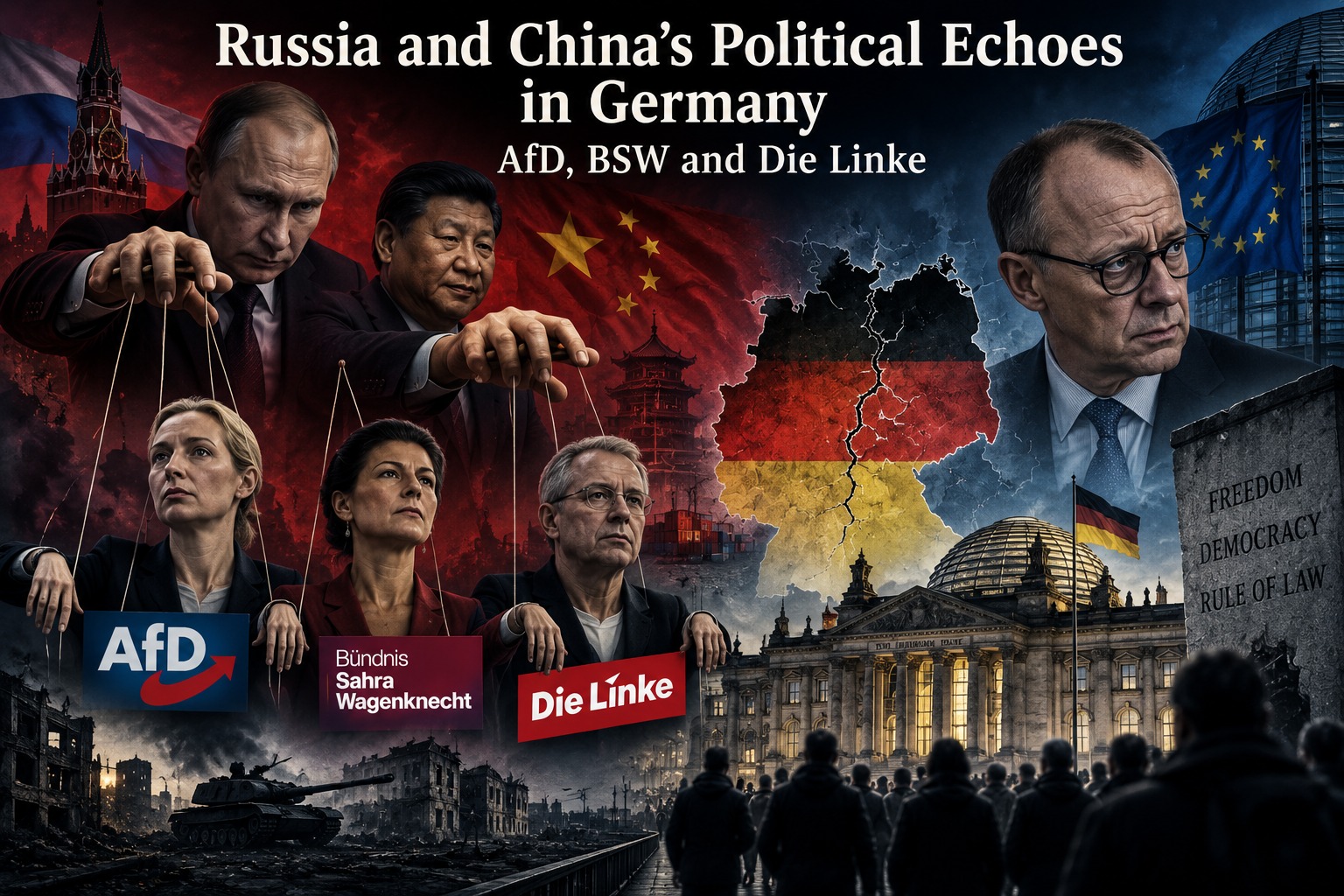
I will present a very important document submitted by the AfD in the German Parliament. In August 2025, the AfD parliamentary group submitted a Große Anfrage (major interpellation) to the German Bundestag entitled “Russian Natural Gas Supplies to Germany and Europe – Strategic Questions Against the Background of Economic and International Realities”, explicitly questioning the impact of the EU initiative to ban Russian gas imports on energy prices, energy security, and Germany’s negotiating position.
The central idea of the document is that Germany’s post-2022 energy strategy represents, in the AfD’s view, a fundamental strategic mistake that should be reversed. The document does considerably more than criticize high energy prices. It attempts to reconstruct the entire pre-2022 German-Russian energy relationship as an economically rational and strategically beneficial model based on mutual interdependence. Step by step, sentence by sentence, the document tries to erase a basic strategic truth: for more than twenty years, Germany deliberately built a relationship of dependence on Russia and then presented that dependence as mutually beneficial interdependence. Russian pipeline gas is presented as cheap, reliable and conducive to German industrial competitiveness, while the post-2022 replacement of Russian pipeline supplies with LNG and alternative suppliers is portrayed as more expensive, less predictable and capable of replacing one form of dependence with another. Within this argument, however, the AfD points to a genuine contradiction in European energy policy: while the European Union is seeking to phase out Russian pipeline gas and oil, imports of Russian liquefied natural gas (LNG) have simultaneously increased substantially compared with the pre-war period: “Following the interruption of Russian pipeline gas imports and deliveries via Nord Stream, European countries increased their imports of Russian LNG to such an extent that Russia exported a record total of 33.6 million tonnes in 2024 […] More than half of these exports went to Europe: a record volume equivalent to 52 percent of total Russian LNG exports in 2024, representing an increase of 4 percent compared with the previous year. European countries thus became the key buyers of Russian LNG, which is more expensive than pipeline gas”[1]. Who were the countries that imported a huge amount of LNG? France, Spain, Belgium and the Netherlands.
This also exposes an apparent contradiction at the heart of German energy policy. Under Olaf Scholz’s “Traffic Light” coalition of the SPD, FDP, and Greens, Germany pursued a policy of reducing direct energy imports from Russia while Russian LNG continued to enter the German market indirectly through other EU member states that themselves imported substantial quantities from Russia. In practice, therefore, the geographical route of Russian gas changed without necessarily eliminating Russian gas from the German market altogether: “Germany, which has prohibited direct Russian LNG deliveries through its ports by means of national legislation, nevertheless purchased a record volume of Russian LNG via France in 2024, according to the Financial Times. The energy ministers of Belgium, France, and Spain, whose ports receive Russian LNG tankers, stated that only a small proportion of the Russian liquefied natural gas arriving in their countries is consumed domestically, while most of it is subsequently transported to other EU member states”[2].
The documents also underline the fact that many EU member states would have extremely big difficulties to adapt to the new economic reality: “In May 2025, as part of REPowerEU, the European Commission presented a new roadmap to end all imports of Russian energy into the EU, including a planned phase-out of all Russian gas imports by the end of 2027”[3]. The document talks about how a possible ban would damage Austria, Slovakia and Hungary. It also points to the fact that Donald Trump would pressure its European allies to buy more LNG from the United States, which could control a renewed economic partnership between Germany and Russia with respect to the import of Russian gas and oil through the pipelines: “internationally significant negotiations between Russia and the United States have reportedly been taking place for months concerning a possible US-controlled resumption of Russian pipeline gas deliveries to the European market. According to people familiar with the talks, <<restoring Moscow’s role in the EU gas market could contribute to a peace agreement>>, while US involvement could help overcome “political resistance” in Europe and simultaneously provide Washington with the opportunity to “control” supply volumes”. Is this true? According to a Reuters investigation published in May 2025, US and Russian officials had discussed possible arrangements through which Washington could facilitate the return of Russian gas to the European market. Citing eight sources familiar with the discussions, Reuters reported that the options considered included US investment in Nord Stream or other gas infrastructure, as well as American companies acting as intermediaries by purchasing Russian gas and reselling it to European customers[4]. Such an arrangement could potentially give Washington greater visibility and even a degree of control over the volume of Russian gas returning to Europe. Reuters further reported that Gazprom was considering offering German customers short-term 24-month contracts and substantial price discounts in an effort to regain access to the European market. However, no formal US-Russian agreement was publicly confirmed, and Russia’s RDIF denied at the time that such discussions were taking place. From the AfD’s perspective, eliminating Russian energy dependence does not automatically produce German strategic autonomy if Germany subsequently becomes increasingly dependent on American LNG or other external suppliers. The party therefore presents diversification away from Russia not necessarily as liberation from geopolitical dependence, but potentially as the substitution of one dependency for another, at a higher economic cost.
Against this background, the AfD portrays Germany’s post-2022 energy policy as economically damaging, strategically contradictory, and contrary to the country’s national interests. The party argues that Germany had benefited for decades from inexpensive and reliable Russian pipeline gas, while the abandonment of this model has exposed German consumers and industry to more expensive LNG and increasingly competitive global energy markets: “until recently Germany had benefited economically for many years from direct, inexpensive and secure Russian pipeline-gas supplies via Nord Stream”[5]. Moreover, even though the European Union is imposing sanctions against Russia, Russia has been able to redirect a large part of its energy exports to other customers, particularly the People’s Republic of China, while Russian gas in the form of LNG continues to reach European and even German consumers indirectly through other EU member states: “Russia is finding new buyers worldwide, particularly in China, for its comparatively inexpensive gas, although in some cases at discounts compared with prices previously paid by the EU […] the Federal Government is instead relying on alternative LNG import sources and thereby, in the authors’ view, contributing to further competition for the limited supply available on the international market”[6]. On the one hand, the German government under Chancellor Friedrich Merz rejected the recommissioning of Nord Stream 1 and 2 and supported EU measures designed to prevent their future use. On the other hand, during this period Russian LNG continued to enter the European energy market through other EU member states, particularly France and Belgium, while Germany remained integrated into this common gas market: “the Federal Government permits German consumers only to receive more expensive Russian LNG indirectly through other EU countries such as France, while prohibiting direct imports from Russia […] the Federal Government, through the 18th sanctions package, has for the time being prohibited any resumption of deliveries of pipeline gas via Nord Stream, which the authors regard as cheaper than LNG”[7]. The party therefore rejects both the EU’s planned phase-out of Russian gas and the sanctions preventing the recommissioning of Nord Stream, portraying these policies as economically irrational and restrictive of German sovereignty. Ultimately, the AfD argues that Germany should determine its energy policy according to its own national economic interests, including through the possible repair and “independent and sovereign recommissioning” of Nord Stream, while avoiding excessive dependence on any single external supplier:
“The authors of the inquiry argue that one of the Federal Government’s primary responsibilities is to defend Germany’s national interest in economic prosperity while avoiding excessive dependence on individual gas suppliers. In their view, this should include the possible and necessary repair of Nord Stream and its independent, sovereign recommissioning”[8]. There is a much deeper problem here.
AfD surpasses being only “pro-Russian”. It now serves the interests of the Russian Federation by portraying Nord Stream as a national interest of Germany. Within the political logic of the document, restoring the pipelines becomes an act of national sovereignty: Germany should determine its energy partnerships according to its own economic interests rather than subordinate them to the geopolitical priorities of its allies or of EU institutions.
What is the logic of the document? What does this document try to achieve?
This document attempts to reverse the logic behind one of the EU’s fundamental strategic assumptions since 2022: that economic sanctions should impose costs on Moscow and reduce Russia’s capacity to sustain its war against Ukraine. The rationale underlying the European sanctions and energy-diversification policy can be reconstructed as a chronological and causal sequence:
1.Russia invades Ukraine. On 24 February 2022, Russia launched its full-scale invasion of Ukraine, fundamentally altering the European security environment and Germany’s relationship with Moscow:
2. Russia can no longer be treated as a reliable strategic energy partner. The invasion forces European governments to reconsider a model in which substantial parts of their energy supply depend on a state that has initiated a major war against a neighbouring European country;
3. Russian energy becomes a security vulnerability, it represents a strategic dependency. What had previously been justified as mutually beneficial economic interdependence increasingly comes to be understood as a strategic dependency capable of limiting European freedom of action and exposing European economies to geopolitical pressure.
4. Reducing this vulnerability requires diversification. Dependence on Russian energy represents a national security risk for Germany. Therefore, members of the EU need to develop broader relations with alternative suppliers, to build the necessary infrastructure and develop alternative sources of energy, even if these alternatives are initially more expensive than Russian pipeline gas;
5. Diversification inevitably entails short-term economic costs. Replacing an energy relationship constructed over several decades cannot occur without higher prices, infrastructure investment, adjustment costs and economic disruption;
6. These short-term costs are accepted in exchange for long-term strategic resilience. The European Union knows that the costs will not be as cheap as the costs of Russian gas and oil. At the same time, economic efficiency is not any more the only criterion in developing future economic relations based on mutual trust. Paying more in the short term is considered preferable to maintaining a structural dependence on a state that is simultaneously regarded as a major security threat;
7. Therefore, the European Union decides to impose economic sanctions against a country that proved to be not only an unreliable partner but also became the biggest security threat for the European Union and for NATO.
The AfD document builds a meta-narrative that wants to reverse this entire causal chain. Rather than treating the economic costs incurred after 2022 as the price of correcting an excessive strategic dependence on Russia, the AfD presents the abandonment of Russian pipeline gas itself as one of the principal strategic errors responsible for Germany’s economic difficulties:
1. Germany abandons the good relationship with the Russian Federation, a relationship that was built for generations. Because of the Russian invasion of Ukraine (the AfD formally recognizes this as an ‘invasion’), certain economic sanctions were imposed that interrupted pipeline deliveries and destroyed the energy model which Germany used to obtain large quantities of inexpensive Russian pipeline gas:
2. The loss of Russian pipeline gas increases Germany’s energy costs. In the AfD’s interpretation, replacing direct pipeline supplies with LNG and alternative sources forces Germany to obtain energy through more expensive supply chains. For AfD, DIVERSIFICATION means an increase in the price of energy. AfD does not take the Russian invasion as a cause for the need for diversification. Instead, it says that diversification is a brutal strategy that will only increase the energy price in the future:
3. Higher energy prices weaken German industrial competitiveness. Because Germany possesses a large energy-intensive industrial sector, AfD presents rising gas and electricity prices as a structural disadvantage for German companies competing with producers in countries where energy remains cheaper;
4. If competitiveness is declining in the energy industrial sector, economic damage will be the next logical consequence. This means higher energy costs, declining investments, higher production costs, the relocation of industrial capacity abroad, higher costs of transport and Germany’s broader economic weakness.
5. Russia is not affected by these economic sanctions imposed by the West. Russia adapts rather than becoming isolated. Even if Russia does not sell so much on the European market, there are alternative sources of buyers for Russia internationally, increasingly redirecting exports towards alternative customers such as China, while Russian LNG continues to enter the European market. Committing itself to this strategy, Germany is continuously destroying its economy, while Russia feels nothing;
6. Germany does not escape the circle of dependency. Why? The AfD document emphasizes that Germany replaces the dependency on Russian gas with the dependency on the United States. Dependence on Russian pipeline gas is replaced, in this narrative, by greater exposure to international LNG markets and suppliers such as the United States. Germany therefore pays more for energy without necessarily achieving genuine energy sovereignty.
7. Self-harm is the only consequence of this sanctions and diversification strategy. This points to the final argument of AfD within this logic. Whereas the EU regards short-term economic costs as a necessary investment in long-term resilience and as part of the pressure imposed on Russia, the AfD portrays those same costs as evidence that the strategy itself has failed. For the EU, the vulnerability is dependence on Russia; for the AfD, the vulnerability is the economic damage created by abandoning inexpensive Russian energy and becoming dependent on more expensive and volatile alternatives. Therefore, according to the AfD party, the only solution is to reconsider the isolation of Russian energy, to lift the sanctions imposed on the Russian Federation, proclaim that Nord Stream 1 and 2 represent a national strategic sovereign asset of Germany and that it should not be harmed, but rather used at the fullest capacity, and allow Germany to define its own national interest not in congruence with the other European partners but rather to its own economic gains.
However, the AfD’s foreign policy cannot be reduced merely to the labels “pro-Russian” or “anti-sanctions.” It forms part of a broader political and ideological trend that has gained considerable momentum across the European Union. The AfD is therefore not an isolated phenomenon, but one manifestation of a wider challenge to the liberal, supranational model of European integration. This trend developed gradually within European societies, fuelled not only by external influence and geopolitical competition, but also by internal political failures. For years, European institutions and established political parties have struggled both to confront increasingly radical anti-EU movements and to respond adequately to the grievances, insecurities, and demands of significant parts of their own societies. Of course, AfD serves the national interests of Russia and China, particularly where they advocate weakening supranational European integration, challenging the existing Western-led international order, reducing sanctions against Russia, or questioning established transatlantic arrangements. However, the liberal democracies are also to blame because they have built a shield from the needs of society, a shield that produced frustration and continuous radicalization within European society.
[1] „Russische Erdgaslieferungen nach Deutschland und Europa – Strategische Fragen vor dem Hintergrund wirtschaftlicher und internationaler Realitäten“, Bundestag, Drucksache 21/1266, 18.08.2025, p. 2, accessed at https://dserver.bundestag.de/btd/21/012/2101266.pdf on 23.08.2026
[2] Ibidem, p. 2
[3] Ibidem, p. 6
[4] Anna HIRTENSTEIN & Marwa RASHAD, “US, Russia explore ways to restore Russian gas flows to Europe, sources say”, Reuters, 8th May 2025, accessed at https://www.reuters.com/business/energy/us-russia-explore-ways-restore-russian-gas-flows-europe-sources-say-2025-05-08/ on 23.08.2026
[5] Ibidem, p. 9
[6] Ibidem, p. 10
[7] Ibidem, p. 10
[8] Ibidem, p. 10

