

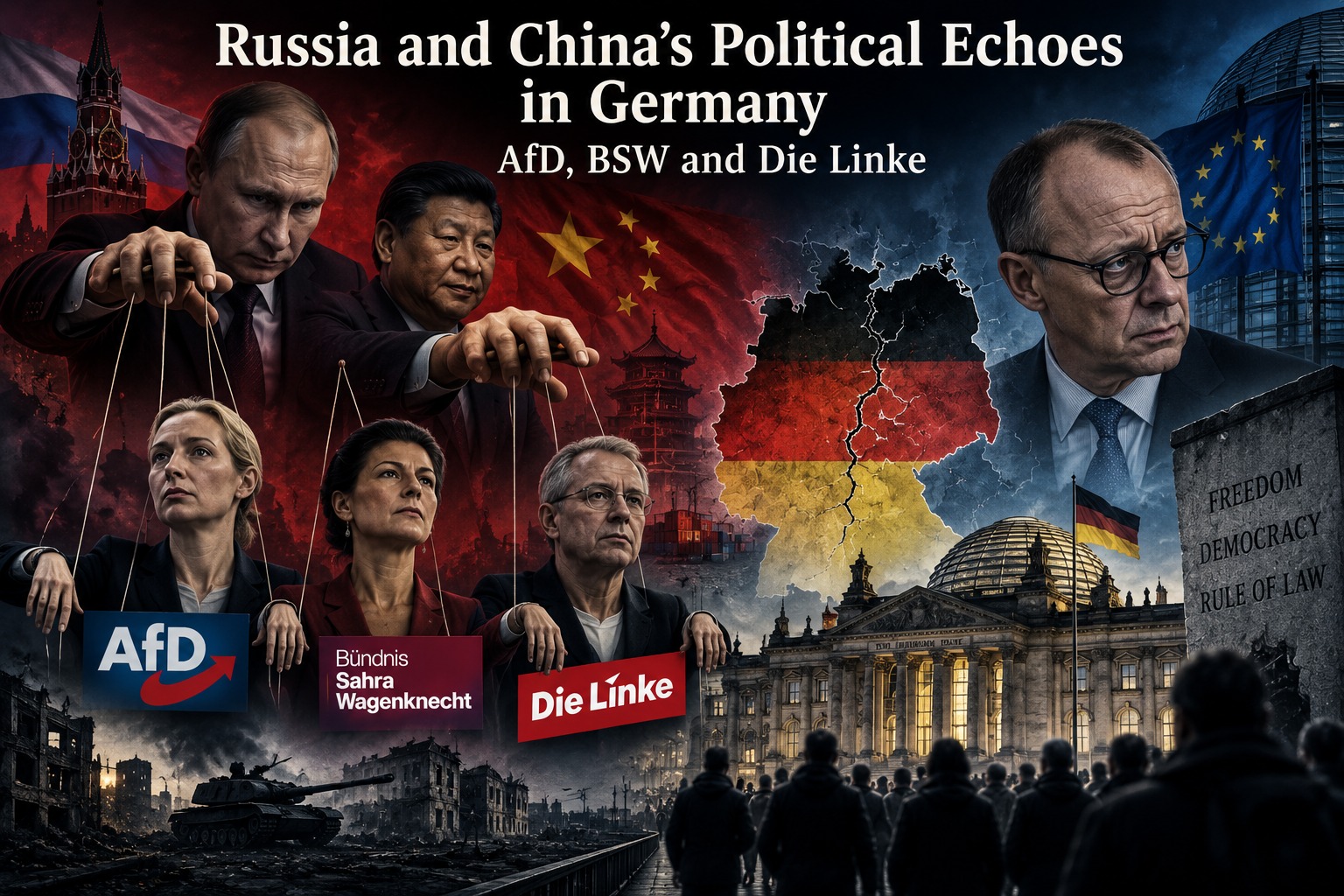
ALTERNATIVE FÜR DEUTSCHLAND: Deconstruction of their narratives
Now that we understand the broader context, we know where we stand and who the adversaries of the European Union and NATO are. We know what the threat looks like from the outside. We understand its tactics, its instruments, and its short-, medium-, and long-term strategies. We understand that Russia, China, North Korea, and Iran have developed an increasingly close strategic partnership directed against the rules-based international order represented, in Europe, primarily by the European Union and NATO.
The next question is therefore unavoidable: What does the threat look like from within? More specifically, what form does it take inside Germany itself? How can external authoritarian powers exploit domestic political forces, social divisions, economic dependencies, networks of influence, disinformation, and existing dissatisfaction in order to advance their strategic interests from within a democratic society?
If we are inside a fortified city and we see the enemy coming to occupy our city, we cannot miss him. An external adversary can be identified, deterred, and, if necessary, confronted. On the other hand, an internal threat is far more difficult to recognize. An internal enemy takes the shape and the form of the city it wants to occupy. It can operate through public institutions, it can influence elections, it can create a disinformation campaign, it can create division within the society, so that the external form can penetrate and weaken better and faster every single strength that the state has. The external enemy does not always remain outside the city walls; it can find its way inside the gates. And this raises a fundamental question: can a state survive when it is under pressure from the outside while simultaneously being undermined from within?
We established that Russia and China are the main political threats when it comes to the geographical area of the European Union. We also said that the external enemy can have multiple faces within a city in the forms of scouts and spies. So one of the faces of the Russian Federation within the European Union takes the form of the ALTERNATIVE FÜR DEUTSCHLAND (the “Alternative for Germany”). This party was formed on 6th February 2013 in Berlin against the backdrop of the European sovereign debt crisis. The party was initially formed to destroy the Eurozone and to weaken the position of the Euro within the European Union. Let us see what the party was proposing in April 2013 when it comes to the Eurozone:
“We demand an orderly dissolution of the euro area. Germany does not need the euro. The euro is harmful to other countries. We demand the reintroduction of national currencies or the creation of smaller and more stable currency unions. The reintroduction of the Deutsche Mark (DM) must not be taboo. We demand an amendment to the European treaties to allow every state to withdraw from the euro. Every nation must have the right to decide democratically on its own currency. We demand that Germany enforce this right to withdraw from the euro by using its veto to block any further financial assistance through the European Stability Mechanism (ESM)”[1].
In other words, from the beginning, the AfD was representing a strange political force, one that tried to sabotage the unity of the European Union and the trust among the EU member states. If this was not enough, AfD proposed that Germany should be out of the Eurozone and adopt its former national currency, the Deutsche Mark. Its proposal was not merely to reform the euro architecture, but to permit an orderly dissolution of the euro area and destroy the European financial unity.
Let us go to the description of AfD from the website of the AfD. What is AfD trying to achieve? What is its intention and what does it want for the future?
“We came together in the firm conviction that citizens have a right to a genuine political alternative—an alternative to what the political class believes it can impose upon us as having “no alternative.” We could no longer stand idly by, nor did we want to, while laws and legal principles were being violated, the rule of law was being undermined, and irresponsible political decisions were being taken in defiance of the principles of economic reason.
Nor were we willing to continue accepting that the euro rescue regime was causing long-overcome prejudices and hostilities between the peoples of Europe to re-emerge. We therefore decided to offer Germany and its citizens a genuine political alternative in all areas”[2].
If one reads this paragraph, one can clearly see some of the main goals of this Russian face in German politics:
1. “Nor were we willing to continue accepting that the euro rescue regime was causing long-overcome prejudices and hostilities between the peoples of Europe to re-emerge”: AfD is advocating for what they were advocating in the first place: to destroy the European Union from inside, starting with the destructiveness of the Euro;
2. “irresponsible political decisions were being taken in defiance of the principles of economic reason”: what is ‘economic reason’ according to the AfD? Which are these ‘irresponsible decisions’ in such close relationship with the economic field? I can find the answer to this question in so many public sources. I will try to use a very credible source: the political program of the Party for the last Parliamentary elections. In their program, they mention the only way Germany will find economic reason and will thrive again as a political and economic force:
“For decades, Russia was a reliable supplier and guarantor of an affordable energy supply, which, due to our energy-intensive industry, represents the Achilles’ heel of the German economy. Restoring unrestricted trade with Russia requires the immediate lifting of economic sanctions against Russia as well as the repair of the Nord Stream pipelines. Germany’s relations with the Eurasian Economic Union should be expanded”[3].
This represents the AfD’s official party line when it comes to foreign policy: the restoration of closer political and economic relations between Germany and the Russian Federation. This is what AfD always wanted; the AfD was from the beginning one of the Russian Trojan horses in Germany. It was not the only one, but it is certainly one of the strongest.
If we look closer at what the AfD officially wants, we can go and look at their official general party program and this we can find on their official website. When I say “general party program”, I refer to the main program of the AfD, not targeted at a specific segment of the population and not pointing to a certain moment. Let me look closer. What do I find?
“For the AfD, a détente in relations with Russia is a prerequisite for lasting peace in Europe. It is in Germany’s interest to integrate Russia into an overarching European security architecture, without disregarding Germany’s own interests or those of its allies.
The AfD advocates an end to the policy of sanctions. Economic cooperation with Russia should be deepened”[4].
Another sign that AfD wants closer cooperation between Germany and the Russian Federation. AfD wants to reintegrate Russia within the European system of ideas, values and principles. A country that not only invaded another country, but that commits genocide against the Ukrainian population, a country that targets NATO countries with drones, sabotage, and espionage, AfD wants to bring this country into Europe. Or, in other words, AfD wants to transform Europe once again into a vassal to the energy provided by the Russian Federation.
Over the years, there were not only isolated party members that were proposing a normalization of the relations between Germany and the Russian Federation, but there was an emerging Russian propaganda apparatus that became a Russian satellite on German soil. The main party lines when it came to the relationship to Russia were composed of: the normalization of relations with Moscow, the rejection of economic sanctions, the preservation and restoration of German-Russian energy ties, and the pursuit of closer economic cooperation with Russia. This became more and more obvious after the election of Donald J. Trump in the United States of America in his second term. That moment was the moment in which the AfD got closer and closer to the Republican Party officials who were very close to Moscow, even supporting the Russian propaganda against Ukraine. When the Biden administration was in Washington, AfD wanted no relations with the US. When the Trump administration came to power, bringing with it political figures who advocated a more accommodating approach towards Russia, the AfD suddenly became markedly more pro-American.
There is a certain continuity when it comes to the AfD statements about the normalization of the relations between Germany and Russia. There are no isolated remarks, no isolated AfD party members, but recurring statements, recurring policy proposals and party positions that underlines how the AfD got closer and closer to the Russian narrative over the past decade. The AfD’s orientation towards Russia did not suddenly emerge after Russia’s full-scale invasion of Ukraine in 2022. Its origins can be traced back to the party’s early years. Although Russia occupied a relatively secondary position during the AfD’s initial, predominantly euro-critical phase in 2013, the party’s Russia policy became increasingly visible following the annexation of Crimea in 2014. Let us take some examples:
1. On 4th February 2016, Alexander Gauland, one of the ‘founding fathers’ of AfD expressed his admiration for the Russian Federation and militarized for the partnership between Germany and Russia:
“We need Russia to solve global crises. The fact that Stoiber and Seehofer are paying their respects to Putin in Moscow is wise […] Unfortunately, Mrs Merkel no longer seems capable of this. Anyone who consistently refuses to speak with Russia on an equal footing, to recognize it as a ‘global player,’ and to include it in international dialogue is making a grave mistake. Russia must not simply be pushed out of the various forums for dialogue because of a misguided sense of solidarity with our ally on the other side of the Atlantic. Especially now, a continuous, solution-oriented dialogue with Russia is more necessary than ever. Sanctions are precisely the wrong approach and are counterproductive”[5].
So one of the founding members of AfD talks about how close Germany and Russia should be in the future and, even though Merkel took a decisive step in normalizing the relationship between Russia and Germany, she still did too little in the vision of AfD. Even though Merkel made a terrible mistake, allowing the construction of the pipeline Nord Stream 2 and completely destroying Germany`s energy independence, AfD considered Merkel`s actions as too insufficient. These statements say something about the true nature of AfD and its intentions if it will be in power in Germany after 5th September;
2. On 7th April 2016, commenting on the referendum in the Netherlands on the Association Agreement between the European Union and Ukraine, Alexander Gauland issued another statement that proved how AfD is doing everything in its power to make Germany more and more dependent on the Russian Federation. AfD wants to transform Germany in a country that does not have any sovereignty when it comes to its own foreign policy. AfD wants Russia to have the last word:
“The voters in the Netherlands have delivered a wise verdict by a clear majority. The agreement with Ukraine is misguided in terms of foreign policy, since it is openly directed against Russia and therefore also disregards the vital interests of European states. Any intensification of cooperation with Ukraine must take place in consensus with Russia. Otherwise, the hoped-for economic benefits will be nullified by confrontation with Russia”[6].
3. On 8 April 2016, Alexander Gauland welcomed the renewed rapprochement between NATO and Russia, particularly the resumption of dialogue within the NATO–Russia Council following the deterioration of relations triggered by Russia’s illegal annexation of Crimea:
“The news that the NATO–Russia Council will meet again within the next two weeks is a positive signal—a ray of hope as the weekend approaches. Both sides must now take further steps to rebuild mutual trust. As a first step, the economic sanctions imposed on each other must also be lifted. At a time of increasing terrorism and the destabilization of entire regions in Asia and Africa, it is important that NATO and Russia work together rather than against each other”[7];
4. On 12th April 2016, Georg Pazderski, another very important member of the AfD until 2024, when he left the party, commented on the same rapprochement between NATO and Russia:
“First and foremost, it is a positive sign that, after such a long period, the NATO–Russia Council is finally meeting again for talks. However, the divisions have become deep—divisions that, not so long ago, we believed had already been overcome. It is now important for both sides to put an end to provocations and mutual accusations. Steps must be taken towards one another. This also includes lifting the sanctions imposed by both sides”[8].
5. When it comes to the same subject, meaning the NATO-Russia Council, Alice Weidel, the current President of the AfD Party, said in April 2016:
“Balance is the key word of the moment. Russia has unjustly been excluded for far too long from dialogue concerning the various crises in Europe and in the Near and Middle East. That was unwise and did nothing to bring us closer to solutions. I welcome the resumption of dialogue within the NATO–Russia Council[…] Russia has just as much of a place at the negotiating table as the North Atlantic Alliance”[9].
Alice Weidel presented herself as the best candidate to become Chancellor of Germany ahead of the February 2025 federal election.
6. On 20th June 2016, Gauland also criticized the participation of the Bundeswehr (the German army) in the NATO exercises in Poland 2016:
“Sabre-rattling and deterrence against Russia are not the right way out of the crisis. Foreign Minister Steinmeier is absolutely right about that. At the latest since the Crimea crisis, it should have become clear to everyone that deterrence against Russia does not work, but instead provokes the opposite reaction. For this reason, particularly now, we should focus on dialogue and cooperation with Russia on an equal footing. This applies to foreign policy and economic policy, but naturally also to military cooperation”[10];
Gauland made this statement in June 2016. Two years earlier, Russia had illegally annexed Crimea and had become militarily involved in eastern Ukraine. In response to the deterioration of the European security environment, NATO had begun strengthening its deterrence and defence posture on its eastern flank. By June 2016, the Alliance was preparing for the Warsaw Summit, where it would subsequently decide to establish an enhanced forward presence consisting of four multinational battlegroups in Poland, Estonia, Latvia and Lithuania.
What do we see in this announcement of the AfD? Who is in their comment? None other than the current President of Germany, Frank-Walter Steinmeier, who in 2008 was the Minister of Foreign Affairs in Germany. He was also in 2016 the Minister of Foreign Affairs of Germany. In a comment that can be found on the website of the Ministry of Foreign Affairs of Germany, Frank-Walter Steinmeier takes a NEUTRAL position towards Russia when it comes to the behavior of Russia towards Crimea and towards Ukraine. This fact represents one of the main mistakes made by Germany for more than 20 years:
“What we should not do now, however, is further inflame the situation with loud sabre-rattling and war cries. Anyone who believes that symbolic tank parades on the Alliance’s eastern border will increase security is wrong. […] After all, history teaches us that, alongside the common will to ensure defence readiness, there must always also be a readiness to engage in dialogue and cooperation[…] We are not sweeping differences of opinion and conflicts under the carpet. At the same time, we have an interest in integrating Russia into an international partnership of responsibility. Current examples include preventing Iran from getting a nuclear bomb, fighting radical Islamism in the Middle East and stabilising state structures in Libya”[11].
What can we see here? A GREAT SIMILARITY BETWEEN THE GERMAN FOREIGN POLICY OF THE MERKEL ADMINSTRATIONS AND THE FOREIGN POLICY GOALS OF THE AFD. This represents one of the sad truths of German foreign policy. Most of the parties agreed with the normalization of the relations between Russia and Germany and, at the same time, had the claim that the United States should maintain the military umbrella to protect Germany, the EU and NATO from the Russian threat. So where is the Russian threat? If you, Angela Merkel, are doing everything in your power to cooperate, collaborate, even to speak Russian with the Russian President, Vladimir Putin, why should the United States pay for your security and the security of all those who are closely collaborating with the enemy?
7. On 29th September 2016, the same Georg Pazderski declared that Germany needs Russia as a partner in economic affairs and not as an adversary:
“A strategy of deterrence not only evokes unpleasant memories of the Cold War; above all, it is not an appropriate means of improving the tense relationship with our large neighbour to the east. Instead of sending German soldiers to Lithuania, the Federal Government should seek dialogue with Putin at all levels. We need Russia as a partner in economic affairs and security, not as a permanent adversary”[12];
8. On 10th January 2017, Georg Pazderski, in the context of the deployment of 4000 NATO troops on the Eastern flank, said that Germany should treat Russia as a partner:
Russia should be treated as a partner on an equal footing, rather than threatening and sanctioning Putin. If we continue to treat Russia condescendingly, we ourselves will ultimately suffer the greater disadvantages from this dispute. Putin’s policy has always been rational and predictable. It therefore should not actually be difficult for us to get along well with him and to conduct good business with Russia”[13].
9. Moreover, on the 21st September 2017, in Berlin, Georg Pazderski said that Gerhard Schröder, the former Chancellor of Germany from the SPD, is right in criticizing the Western sanctions against Russia. This underlines the fact that AfD’s position is only a continuation and a radicalization of the foreign policy of Merkel and Schröder towards Russia:
“Former Chancellor Schröder is absolutely right in his criticism of Germany’s policy towards Russia. Provocations such as the deployment of Bundeswehr soldiers in the Baltic states are not only symbolic gestures that disregard the lessons of history; they also run counter to German interests. Germany must have a fundamental interest in maintaining good and cooperative relations with Russia”[14];
10. On 28 November 2017, two AfD members of the Bundestag, Dr Anton Friesen and Waldemar Herdt, participated at the event called “German-Russian Business Talks”, organized by the German-Russian Economic Alliance (Deutsch-Russische Wirtschaftsallianz e.V.) in cooperation with the Trade and Economic Office of the Embassy of the Russian Federation. Both were in favor of continuing the economic and energetic cooperation between Germany and the Russian Federation.
“In Germany, SMEs generate around 40 percent of all taxable turnover, provide more than 60 percent of jobs and train more than 80 percent of all apprentices. They are therefore a guarantor of prosperity in Germany. In Russia, we see tremendous opportunities and enormous potential for cooperation in this area […] We all know from historical experience that whenever Russia and Germany have lived and worked together peacefully, not only have the peoples of these two countries benefited, but the entire world has benefited as well”[15] said Waldemar Herdt.
Dr. Anton Friesen went further with the argument and proposed something that would have been extremely dangerous not only for Germany, but also for the security of the European Union and for NATO as well. He proposed a FREE TRADE AREA BETWEEN THE EUROPEAN UNION AND THE EURASIAN ECONOMIC UNION, which is a regional organization created by the Russian Federation with the former countries that were part of the Soviet Union:
“Russia is a key trading partner for Germany. […] As part of its import-substitution policy, the Russian state promotes investment, joint ventures and collaborative research and development projects. What we need is a free-trade area between the European Union and the Eurasian Economic Union, the abolition of visa requirements, and cooperation particularly in future technologies such as nanotechnology, biomedicine and artificial intelligence”[16];
11. A former member of the AfD, Prof. Dr Jörg Meuthen, on 20th July 2018, after he was on a trip to the Russian Federation, he underlined the need for a strong relationship between Germany and Russia, both culturally and economically:
“Through my trip, which received extensive media coverage in Russia, I was able to contribute to improving the dialogue between our countries, something that was received very positively there. Germany and Russia are two great cultural nations that have always prospered when they were peacefully and amicably connected, while experiencing horrific chapters in their history whenever this was not the case”[17].
12. On 22nd of August 2019, Alexander Gauland pleaded for the inclusion of Russia among the group of the world’s leading industrialized nations:
“The leading industrialized nations should no longer exclude Russia from their dialogue. It is also in Germany’s interest to maintain good economic and political relations with Russia. In many areas, such as energy supply and security policy, Russia is indispensable.
Russia’s exclusion from the G7 has achieved nothing: Russia has not returned Crimea because of it, nor will it do so. On the contrary, if we continue to refuse dialogue with Russia, we will continue to lose opportunities to exert influence and squander one economic opportunity after another”[18];
13. Steffen Kotre, a member of the AfD and a former member of the German Bundestag, in a debate in the German Parliament, underlined the need for Russian gas on the German market. Kotre’s assertion that Russia had never instrumentalized energy supplies is highly contestable, particularly in light of Moscow’s subsequent conduct on European energy markets. He even proposed that Germany and Russia should also build Nord Stream 3 because Germany should have more gas through a new pipeline, not only through Nord Stream 1 and Nord Stream 2:
“Nord Stream 2 supplies only 55 billion cubic metres of gas annually; that is not even half. Taking this line of thought further, one could even consider whether we should start planning a Nord Stream 3. Russian gas is inexpensive; indeed, it appears to be the cheapest gas available on the market. The Russians have never let us down. They have never used raw-material supplies as a weapon. They have always delivered reliably, even during the Cold War, when they would certainly have had stronger motives to turn off the gas tap. Russia has never blackmailed us either”[19].
14. After Russia’s full-scale invasion of Ukraine on 24 February 2022, the AfD adopted what increasingly resembled a political master plan: they condemned the invasion itself and, at the same time, through this action, they created the illusion that AfD has no ties with the Russian Federation. What happens next? They focus on delivering the message from before the invasion, meaning that Germany and the EU can achieve their interests only through “peace and diplomacy” with the Russian Federation. They go beyond words, and they propose a stop to the delivery of weapons to Ukraine, and they want to end each and every sanction against the aggressor, meaning against Russia. If this was not enough, they also advocate for the restoration of Russian energy supplies to Germany, including through Nord Stream 2. They twisted their narrative for their own political advantage. This is the official message of the AfD after the invasion:
“Der Angriff Russlands auf die Ukraine ist durch nichts gerechtfertigt. Russland muss die Kampfhandlungen umgehend einstellen und seine Truppen aus der Ukraine zurückziehen. Die Lösung zwischenstaatlicher Konflikte kann nur am Verhandlungstisch erfolgen. In den Gesprächen müssen dem russischen Partner endlich glaubwürdige Angebote gemacht werden, die das gegenseitige Vertrauen wieder stärken. Die Bundesregierung hat bei allen Versuchen, gemeinsam mit unseren Verbündeten eine friedliche Lösung des Konflikts herbeizuführen, die Unterstützung der AfD-Fraktion”[20];
15. On 23rd June 2022, Tino Chrupalla, one of the strongest German politicians at the moment, said that the decision of Chancellor Olaf Scholz to end the Nord Stream 2 project was a big mistake and pleaded for a reopening of the relations between Germany and the Russian Federation and to end the economic sanctions imposed against Russia:
“The declaration of the alert level will make natural gas considerably more expensive for consumers. And this is happening solely because the Federal Government, through its interference in the war in Ukraine and its sanctions policy, is cutting us off from Russian gas supplies […] We demand an end to the sanctions against Russia and the commissioning of Nord Stream 2”[21];
16. 17. On 11th July 2022, Tino Chrupalla formulated the core idea of what AfD thinks about the way in which Germany should act in relation to the Russian Federation.
“Federal Minister for Economic Affairs Habeck has declared economic war on Russia. German companies and consumers are the victims of this war. Although Germany itself was not under threat, the governing coalition has manoeuvred our country into a state of economic warfare through sanctions and arms deliveries. It is now high time for de-escalation. Arms deliveries must be stopped and the sanctions must be lifted. Further sanctions must be taken off the table. Russian gas must flow to Germany through all available pipelines. The war in Ukraine can only be brought to an end through diplomacy, not through economic suicide”[22].
This statement brings together almost all the central elements of the AfD’s emerging position on the war in Ukraine in 2022. The AfD makes a twist of the implications of the Russian aggression against Ukraine. When we look at the facts, we see that Germany and the European Union as a whole are clearly threatened by the Russian Federation. Because Russia attacks Ukraine, the EU needs to respond to this aggression. Not militarily, but through sanctions. Tino Chrupalla reverses the way in which one can look at the events and portrays Germany and the EU as victims of their own sanctions. In this narrative, Europe and Germany choose to inflict economic damage on European companies and consumers, portraying a successful economic campaign against Russia. AfD builds a grand theory around the idea of the war in Ukraine, which is very similar to what Russia is underlining: Germany makes the fatal mistake of destroying its own companies and its own industry, because its sanctions do not affect Russia. What is the solution proposed by Tino Chrupalla? TO END the sanctions’ regime, to end the military assistance of Ukraine, reject further punitive economic measures, restore Russian gas imports through all available pipelines, and prioritize negotiations with Moscow. The only way to save Germany’s economy is renewed economic cooperation with Russia, not a further decoupling from the Russian energy system. And the only way to achieve this goal is through DIPLOMACY.
17. On 31st August 2022, Alice Weidel called on the German government to reverse its sanctions policy towards Russia and restore Russian gas supplies to Germany, including by putting the Nord Stream 2 pipeline into operation.
“The Federal Government must abolish the gas levy, put Nord Stream 2 into operation, lift the sanctions against Russia, and ensure a secure energy supply by making use of different technologies and maintaining a diversified energy mix”[23];
In order for the propaganda and the disinformation campaign to be credible to the public, it always combines truth with lies. It cannot survive only through lies because the general public would wake up much faster. Instead, it mixes truth in the form of official reports, pieces of information from official mainstream media, with an interpretation that suits the narrative, an interpretation that guides the reader to their narrative.
[1] “Wahlprogramm Parteitagsbeschluss vom 14.04.2013”, p. 1, accessed at https://www.abgeordnetenwatch.de/sites/default/files/election-program-files/afd_1.pdf on 19.08.2026
[2] “Alternative für Deutschland”, accessed at https://www.afd.de/partei/ on 19.08.2026
[3] “ZEIT FÜR DEUTSCHLAND. PROGRAMM DER ALTERNATIVE FÜR DEUTSCHLAND FÜR DIE WAHL ZUM 21. DEUTSCHEN BUNDESTAG”, Alternative fur Deutschland, pp. 91-92, accessed at https://www.afd.de/wp-content/uploads/2025/02/AfD_Bundestagswahlprogramm2025_web.pdf on 19.08.2026
[4] „Außenpolitik | Sicherheit“, AfD, accessed at https://www.afd.de/aussenpolitik_sicherheit/ on 20.08.2026
[5] „Gauland: Seehofer zeigt gesunden Realismus“, Alternative für Deutschland, 4th February 2016, accessed at https://www.afd.de/gauland-seehofer-zeigt-gesunden-realismus/ on 22.08.2026
[6] “Gauland: Europa emanzipiert sich dank der Niederlande”, Alternative für Deutschland, 7th April 2016, accessed at https://www.afd.de/gauland-europa-emanzipiert-sich-dank-der-niederlande/ on 22.08.2026
[7] „Gauland: Nato-Russland-Rat setzt positives Signal“, Alternative für Deutschland, 8th April 2016, accessed at https://www.afd.de/gauland-nato-russland-rat-setzt-positives-signal/ on 22.08.2026
[8] „Pazderski: Nato-Russland-Rat muss seiner Verantwortung gerecht werden“, 12th April 2016, Alternative für Deutschland, accessed at https://www.afd.de/pazderski-nato-russland-rat-muss-seiner-verantwortung-gerecht-werden/ on 22.08.2026
[9] „Weidel: Russland gehört genauso an den Verhandlungstisch wie der Nordatlantikpakt“, Alternative für Deutschland, 22th April 2016, accessed at https://www.afd.de/weidel-russland-gehoert-genauso-an-den-verhandlungstisch-wie-der-nordatlantikpakt/ on 22.08.2026
[10] “Gauland: Nicht provozieren, sondern kooperieren“, Alternative für Deutschland, 20th June 2016, accessed at https://www.afd.de/gauland-nicht-provozieren-sondern-kooperieren/ on 22.08.2026
[11] „Foreign Minister Frank-Walter Steinmeier on relations between NATO and Russia“, Auswärtiges Amt, 19.06.2016, acccessed at https://www.auswaertiges-amt.de/en/newsroom/news/160619-bm-bild-am-sonntag-engl-version-281356 on 22.08.2026
[12] “Pazderski: Dialog mit Russland statt Abschreckung”, Alternative für Deutschland, 29th September 2016, accessed at https://www.afd.de/pazderski-dialog-mit-russland-statt-abschreckung/ on 22.08.2026
[13] “Pazderski: Dialog statt Militärmanöver”, Alternative für Deutschland, 20th January 2017, accessed at https://www.afd.de/pazderski-dialog-statt-militaermanoever/ on 22.08.2026
[14] “Georg Pazderski: Gute Beziehungen zu Russland im deutschen Interesse”, Alternative für Deutschland, 21st September 2017, accessed at https://www.afd.de/georg-pazderski-gute-beziehungen-zu-russland-im-deutschen-interesse/ on 22.08.2026
[15] „Friesen/Herdt: Wirtschaftskooperation statt politischer Konfrontation“, Alternative für Deutschland, accessed at https://afdbundestag.de/friesenherdt-wirtschaftskooperation-statt-politischer-konfrontation/ on 22.08.2026
[16] Ibidem
[17] “Jörg Meuthen: Dialog und Kooperation mit Russland statt Konfrontation und sinnlose Sanktionen”, Alternative für Deutschland, 20th July 2018, accessed at https://www.afd.de/joerg-meuthen-dialog-und-kooperation-mit-russland-statt-konfrontation-und-sinnlose-sanktionen/ on 22.08.2026
[18] „Alexander Gauland: Russland wieder in den Kreis der wichtigsten Industrienationen aufnehmen“, Alternative für Deutschland, 22nd August 2019, accessed at https://www.afd.de/alexander-gauland-russland-wieder-in-den-kreis-der-wichtigsten-industrienationen-aufnehmen/ on 22.08.2026
[19] Deutscher Bundestag Stenografischer Bericht 124. Sitzung Berlin, Donnerstag, den 7. November 2019, p. 151, accessed at https://dserver.bundestag.de/btp/19/19124.pdf on 22.08.2026
[20] “Alice Weidel/Tino Chrupalla: Russischer Angriff ist durch nichts gerechtfertigt”, Alternative für Deutschland, accessed at https://afdbundestag.de/alice-weidel-tino-chrupalla-russischer-angriff-ist-durch-nichts-gerechtfertigt/ on 22.08.2026
[21] „Tino Chrupalla: Der Gasnotfall ist hausgemacht!“, Alternative für Deutschland, 23rd June 2022, accessed at https://www.afd.de/tino-chrupalla-der-gasnotfall-ist-hausgemacht/ on 22.08.2026
[22] „Tino Chrupalla: Die Bundesregierung muss die Versorgungssicherheit gewährleisten“, 11th July 2022, accessed at https://www.afd.de/tino-chrupalla-die-bundesregierung-muss-die-versorgungssicherheit-gewaehrleisten/ on 23,08.2026
[23] “Alice Weidel: Pläne des Energieministers nicht ausreichend”, Alternative für Deutschland, 23rd of June 2022, accessed at https://www.afd.de/alice-weidel-plaene-des-energieministers-nicht-ausreichend/ on 22.08.2026

